AI Tax Compliance: How It Works, Risks, and What to Check

AI tax compliance is when artificial intelligence models do the tax research and determination work that manual tax research teams used to do. It covers registration, determination, calculation, tax filing, and monitoring.
While AI can now take over the heavy lifting, one thing that doesn’t change is that your business remains accountable for all taxing decisions you make.
It's important to note that "AI tax compliance" covers three different things: AI-native systems, legacy tax engines with AI added on top, and AI research chatbots. This guide sorts them out and shows you what to check before you trust any tool with your vital tax processes.
What Is AI Tax Compliance?
AI tax compliance is software that uses AI to replace the manual research and determination layer of tax compliance. The AI reads tax laws and proposes how each product is taxed. It is not a simple rules engine or lookup table.
A tax determination answers three questions. Is this product taxable? At what rate? In which jurisdiction? Traditionally, a team of people answered those questions for every product in every state and country. With AI tax compliance, a model does the first pass and humans double check it afterward.
This matters most for indirect tax, like sales tax, VAT, and GST because a t-shirt, a frozen pizza, and a SaaS software subscription can all be taxed differently in the same city.
AI-Native Platforms vs AI Added to Existing Tax Engines
AI-native platforms use AI to create the tax determinations themselves. Legacy platforms use AI for the tasks around the determinations.
For example, Thomson Reuters launched ONESOURCE Sales and Use Tax AI in January 2026. It uses agentic AI for data import, validation, and tax return mapping. But the determinations underneath still come from a matrix built by hand. In an AI-native system like Sphere, the AI reads the law and proposes the determination.
AI Compliance Systems vs AI Tax Research Assistants
AI tax research assistants help a person answer a tax question. AI compliance systems run compliance for a business.
CPAs use research assistants like Blue J and TaxGPT, or general chatbots like ChatGPT, for tax planning, income tax questions, and tax preparation. None of these tools calculate tax at checkout or file your returns.
Machine Learning, Generative AI, and Agentic AI in Tax
Machine learning, generative AI, and agentic AI do three different jobs in tax.
- Machine learning spots patterns. Tax tools use it for anomaly detection and predictive analytics.
- Generative AI (GenAI) drafts and summarizes. It runs on large language models (LLMs) that use natural language processing to read tax law.
- Agentic AI carries out multi-step tasks. AI agents can pull data, fill in a return, and submit it.
Think of assisted and agentic work as a sliding scale. "Fully hands-off" is not the default. Most tax workflows still pause for human approval.
6 Best AI Tax Compliance Tools
The six best AI tax compliance tools are Sphere, Kintsugi, Numeral, Fonoa, Taxually, and Taxwire. As you shop for a vendor, compare where each one uses AI.
Tool | Where AI Is Used (Research, Classification, Filing) | AI in Live Calculation? | Tax Types | Geographic Coverage | Pricing Model | Best For |
|---|---|---|---|---|---|---|
Sphere | Research, classification, monitoring, registration, and filing | No. A deterministic engine calculates tax from human-approved rules | Sales tax, VAT, GST | US and global | Flat $100 per region per month on Starter; custom for 10+ regions | Companies selling cross-border |
Kintsugi | Classification, nexus monitoring, data cleanup, and filing | Not clearly disclosed. Ask the vendor | Sales tax, VAT, GST | US first; monitoring in 100+ countries | Free tier; $75 per filing or registration; custom Premium plan | Online sellers focused on US sales tax |
Numeral | Workflow automation, classification, and filing | Not clearly disclosed. Ask the vendor | Sales tax, some VAT | US first; vendor says 70+ countries | $75 per filing; $150 per registration | Online sellers in a handful of states |
Fonoa | Monitoring tax rule changes and tax content | Not clearly disclosed. Ask the vendor | VAT, GST, sales tax | Vendor says 200+ countries for calculation | Custom, usage-based | Marketplaces and digital platforms with high volumes |
Taxually | Threshold monitoring and fixing data errors | Not clearly disclosed. Ask the vendor | VAT, GST, sales tax, EPR | Strongest in the EU; monitors 100+ markets | Subscription; varies by country | E-commerce sellers who need EU VAT |
Taxwire | Product labeling, calculation, and support agents | Vendor describes an AI-native calculation engine. Ask how changes are reviewed | Sales tax, VAT, GST | US first; vendor says 100+ countries | $100 per return; $150 per state registration | Growing US companies that want a managed service |
Vendor details are based on each company's public materials as of October 2026. Always confirm pricing and features with the vendor.
1. Sphere: AI-Native Global Tax Compliance
Sphere is an AI-native platform for sales tax, VAT, and GST. Its AI model, TRAM, reads tax law and proposes determinations, and in-house tax experts approve each one. Companies like ElevenLabs, Replit, and Runway use Sphere.
Key features:
- AI-powered determinations with citations to the source law
- Automatic tax code suggestions and real-time monitoring of your tax obligations
- AI agents that prepare, check, and submit registrations and filings
- Integrations with Stripe, Shopify, and QuickBooks
Best for: Companies that want US and international tax in one place. Learn more at Sphere.
2. Kintsugi: AI-Driven Sales Tax Automation
Kintsugi uses AI to classify products, clean up transaction data, and track nexus.
Key features: Free nexus monitoring, AI product classification, and an in-app AI assistant.
Best for: Online sellers whose main need is US sales tax.
3. Numeral: Sales Tax Automation for Online Sellers
Numeral automates US sales tax registration, filing, and payment.
Key features: Free monitoring, automatic registration, and automatic tax code classification.
Best for: Sellers filing in a few states. Costs rise as you add states.
4. Fonoa: International VAT and GST Automation
Fonoa is an API-first platform that uses AI plus human checks to track tax rule changes.
Key features: Tax ID validation, tax calculation, e-invoicing, and returns.
Best for: High-volume marketplaces with an engineering team.
5. Taxually: EU VAT Registration and Filing
Taxually automates VAT registration, calculation, and filing for European sellers.
Key features: AI threshold monitoring, machine learning that corrects data errors, and EPR compliance.
Best for: E-commerce sellers shipping physical goods into the EU.
6. Taxwire: Early-Stage US Sales Tax Tool
Taxwire pairs an AI tax engine with an in-house tax team. It raised $25 million in 2026.
Key features: AI product labeling, human review of every return, and Slack-based support.
Best for: Growing US companies that want a managed service.
How AI Tax Compliance Works Step by Step
AI tax compliance works in six steps, from reading the law to filing the return.
- Ingest and monitor tax law. The system tracks statutes, administrative guidance, and case law continuously, not in periodic reviews the way human teams have to.
- Classify products and services. The AI reads a plain-language product description and assigns the right tax codes to each product.
- Propose a determination. A reasoning model proposes taxability, rate, and jurisdiction, with citations and reasoning.
- Human expert review. A tax expert reviews and corrects the proposal before it becomes a rule. The model learns from each correction and improves with each round of feedback.
- Calculate at transaction time. A tax determination engine applies the approved rule using the tax code and customer location.
- Agentic filing. AI agents map data to return forms and submit filings. Sphere's AI agents handle data entry, validation, and submission with complete audit trails.
Traditional vs AI-Driven Tax Compliance
Traditional tax engines rely on people to build rules by hand. AI-driven engines use a model to propose rules, which are then approved by people.
How Traditional Tax Engines Are Built
Traditional tax engines are built manually by research teams who read the tax regulations in each jurisdiction. They record the answers in a determination matrix, with tax codes as rows and jurisdictions as columns.
The matrix gets reviewed periodically. To keep it manageable, similar products get lumped together. That limits detail, delays updates and may mean that products are classified incorrectly. These manual processes are also why legacy vendors are slow to add new countries.
How Sphere’s TRAM Replaces the Manual Matrix
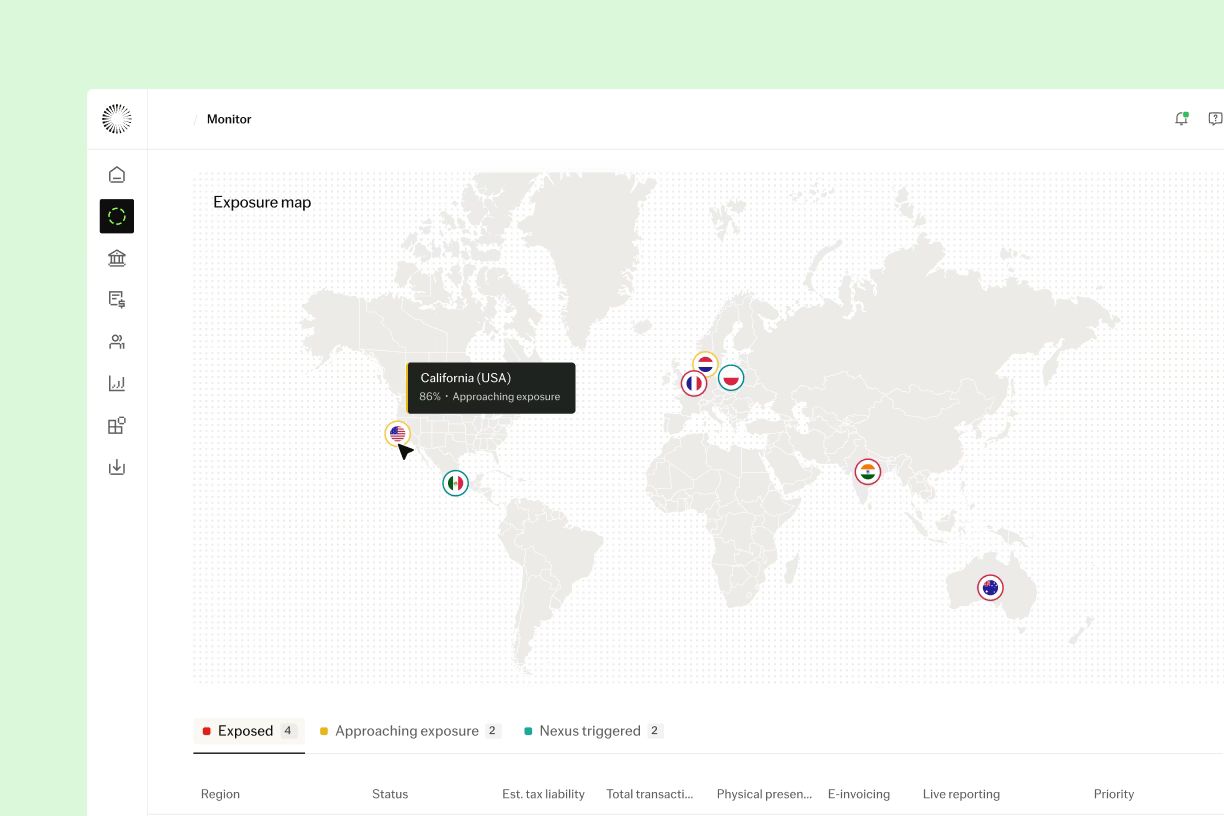
The Tax Review and Assessment Model (TRAM) is Sphere's AI-native tax engine that reads and monitors tax law directly. A fine-tuned reasoning model proposes each determination with citations, and Sphere's tax experts review each one before it's codified.
Sphere has published its results:
- Review time: Under 10 seconds per determination, down from approximately 2 minutes.
- First-shot accuracy: The share of proposals needing no edits rose from under 65% to over 90% by November 2025. Sphere now reports 96%+ first shot and 99%+ after expert review.
Read more about Sphere’s Tax Review and Assessment Model (TRAM) here.
Dimension | Traditional Tax Engine | AI-Native Tax Engine |
|---|---|---|
Research method | People read the law by hand | AI reads the law and proposes answers with citations |
Update frequency | Periodic reviews | Continuous monitoring |
Granularity | Limited. Similar products get grouped to keep the matrix manageable | Detailed. Each product type can get its own treatment |
Review process | Researchers check their own manual work | Tax experts approve every AI proposal before it goes live |
Audit trail | Often spreadsheets and notes | A full log with sources for every determination |
Speed of expansion | Slow. Each new country needs more researchers | Fast. The same system extends to new countries and products |
Can You Trust AI With Tax Compliance?
You can trust AI with tax compliance when the system cites its sources, has a human review every determination, logs everything, and keeps AI out of the live tax calculation.
The Real Risks of AI in Tax
AI tools can make up properly formatted citations, rely on outdated guidance, and give wrong answers in confident language.
Because tax errors repeat on every sale, one wrong rate can spread across thousands of transactions before anyone notices. That hurts your financial reporting and audit readiness.
Why Purpose-Built Systems Reduce Those Risks
Purpose-built compliance systems reduce AI risk by grounding the model in current law and requiring human review. The risk is highest with general-purpose AI that has neither.
A purpose-built system retrieves the current statute first, then reasons from it. An expert checks the result before anyone uses it. That's basic risk management.
Why AI Should Stay Out of the Live Calculation Path
AI should stay out of live tax calculation because a calculation has to give the same answer every time.
As Sphere's reps put it, "the model hallucinated the rate in Portugal" is not a sentence anyone wants to say to an auditor. In Sphere's design, AI proposes and humans approve. A rules-based, deterministic engine calculates tax on live transactions, with a full audit trail for every determination.
Who Stays Accountable When AI Is Used
The taxpayer stays accountable when AI is used. Your business is still liable for its filings. The IRS states that its Circular 230 applies to generative AI, including due diligence, competence, and supervision.
Don’t forget data security. Before sending taxpayer data to a third-party AI tool, check how the vendor stores and uses it.
Why AI Tax Compliance Is Gaining Momentum
AI tax compliance is gaining momentum because tax teams are adopting AI, tax law is changing fast, and even tax authorities are already using AI.
Tax Teams Are Adopting AI Fast
In a June 2026 Blue J and CPA.com survey of 1,000 US tax professionals, 60% said they use AI for tax research at least weekly, up from 33% in 2025. AI is becoming normalized in tax technology.
Tax Law and Mandates Are Outpacing Manual Research
Tax rules now change faster than a manual research team can follow.
- Economic nexus. These US rules trace back to South Dakota v. Wayfair (2018) and keep changing state by state.
- E-invoicing. 2026 brings the largest wave of e-invoicing mandates yet, including Belgium, Poland, and France.
Both trends add new regulatory requirements, and businesses who monitor tax laws continuously have a leg up on businesses who rely on manual tax research and monitoring.
Tax Authorities Already Use AI
Tax authorities use AI for risk assessment, audit selection, and fraud detection. More than 70% of tax administrations in the OECD's Forum on Tax Administration use AI.
The GAO reports that the IRS uses AI models to help choose returns for audit. Agencies also use data analytics to match information returns against filed returns.
That makes complete and accurate compliance processes all the more important. Still, a mismatch or risk score is a lead for review, not proof of noncompliance. And not every scoring system is AI. The IRS DIF score, for example, is a statistical formula.
How to Evaluate and Adopt an AI Tax Compliance Platform
To evaluate an AI tax compliance platform, ask where the AI works in the process and then test it on work you've already checked.
Questions to Ask Any AI Tax Vendor
- Does it cite its sources?
- Does a human review each determination before it goes live?
- Is there a full audit trail?
- Does AI ever touch the engine that calculates tax on live transactions?
- How is live customer data handled?
How to Run a Controlled Pilot
Run a controlled pilot by testing one workflow against results you already trust.
- Pick one repetitive workflow and define success: accuracy, review time, exception rate, and traceability to inputs.
- Test on previously reviewed cases. Reconcile outputs to source documents, recompute key calculations, and open every cited authority.
- Assign named approvers and expand only after the pilot meets its criteria.
Building the Internal Business Case for Switching
When it comes to switching from your legacy tax solution to an AI-powered one, the evaluator is often already convinced. The hard part is persuading leadership to leave a familiar vendor instead of renewing. Sphere's flat regional pricing and full determination audit trail support that case. You also replace the spreadsheets and document management used to track rule changes, which helps with regulatory compliance.
AI Tax Compliance Works Best With Humans in the Loop
AI tax compliance works best when AI does the research and humans make the final call.
AI-native compliance turns periodic manual research into continuous, cited proposals. Trust comes from the architecture: human review, audit trails, and AI kept out of live calculation. Sphere is built on that model across sales tax, VAT, and GST.
Frequently asked questions

Ready to automate your global tax compliance with AI?
Schedule a demo with Sphere today