EU VAT Compliance: Rules, Registration & OSS Guide

EU VAT compliance is the process of working out how VAT applies to your EU sales, registering where required, charging the correct VAT rate, and filing and paying your VAT returns on time. The One Stop Shop (OSS) and the Import One-Stop Shop (IOSS) simplify cross-border reporting on sales to consumers. But they do not replace every local obligation.
These rules apply whether your business is based in Berlin or Boston. EU-based companies and non-EU companies, including US sellers, both have VAT obligations when they supply goods or digital services to EU customers. This guide explains who must register, how OSS, IOSS, and the reverse charge work, and what is changing under VAT in the Digital Age (ViDA).
What EU VAT Compliance Means and Where VAT Is Due
EU VAT compliance means meeting your VAT obligations under the EU VAT Directive in every EU member state where you owe tax. That covers four factors:
- charging the right VAT rate
- registering where required to collect VAT
- issuing correct VAT invoices
- filing and paying VAT on time
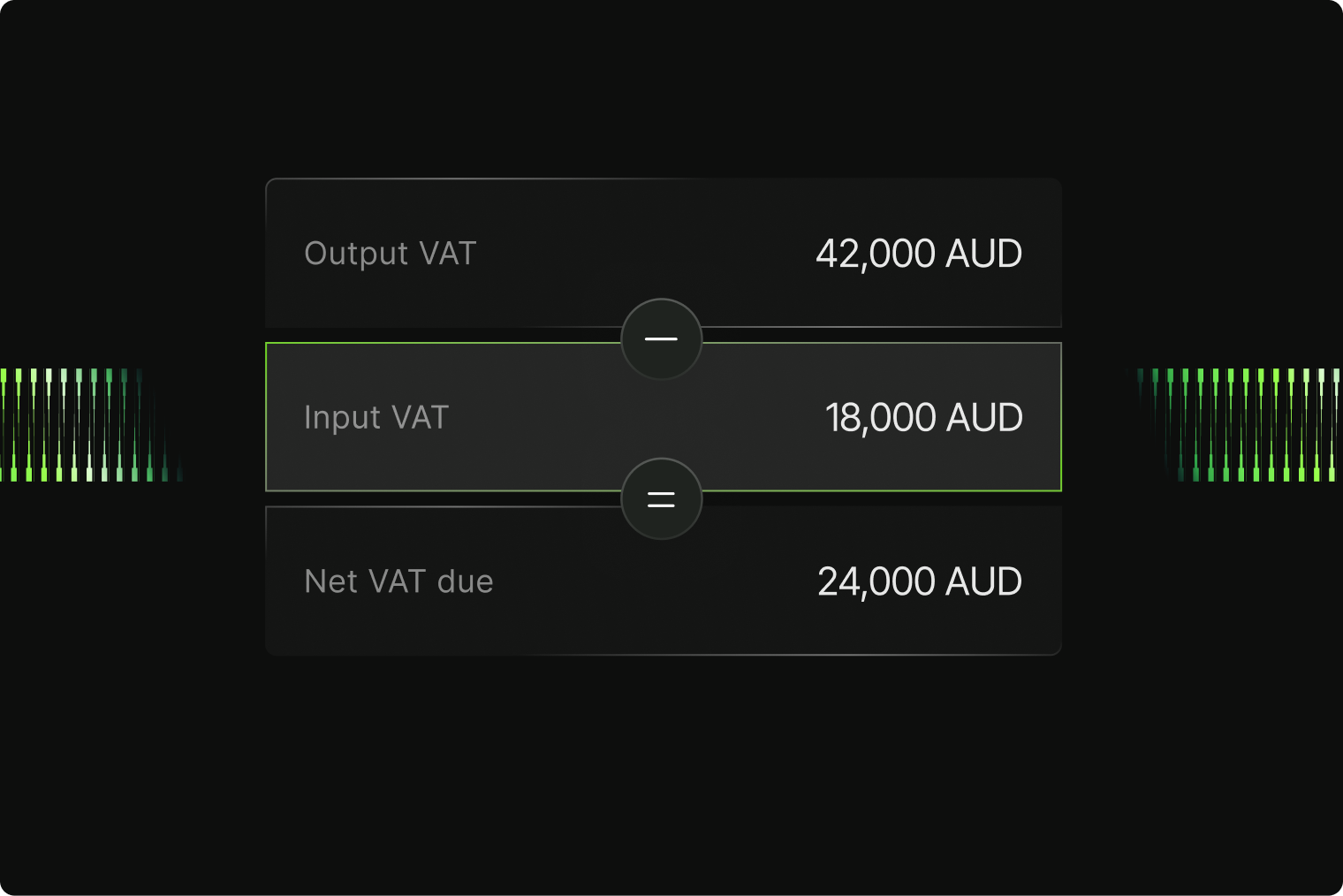
Value added tax (VAT) is an indirect consumption tax. The final customer bears the cost, but businesses collect it in pieces along the supply chain. Each business charges VAT on its sales, deducts the VAT it paid on its purchases, and sends the difference to the tax authorities.
The EU VAT Directive sets the common rulebook for supplies of goods or services. It requires a standard rate of at least 15%. Each of the 27 member states then sets its own EU VAT rates. Standard VAT rates currently range from a low of 17% in Luxembourg to a high of 27% in Hungary. Most countries also apply reduced VAT rates to items like food and medicine. Reduced rates and exemptions narrow the VAT base, so the same product can be taxed very differently from one country to the next. Some supplies, such as many financial services, get a VAT exemption.
When selling cross-border to consumers, EU VAT is destination-based, meaning the “place of supply” is your customer’s location rather than your own. For example, once you’re above the €10,000 threshold (or from your first sale as a non-EU business), you charge a shopper in Hungary the 27% Hungarian VAT rate.
It's important to note that the Directive is harmonized, not uniform. Each member state runs its own registration process, filing calendar, and penalty system. Two countries can treat the same sale differently. That is why EU VAT regulations are like trying to follow 27 varied sets of rules.
Do I Need to Register for VAT in Every EU Country I Sell Into?
Most businesses do not need a VAT registration in every EU country they sell into. But the answer to this question depends on who you sell to, how much you sell, and where your goods sit.
Your situation | Register in each country? | What to do |
|---|---|---|
You sell B2B to customers with validated VAT numbers | Generally no | The reverse charge mechanism generally shifts the VAT liability to your customer |
You sell B2C, and your cross-border EU sales are under €10,000 a year | No | Charge your home country's VAT rate |
You sell B2C, and your cross-border EU sales are over €10,000 a year | No | Register once for OSS, or use IOSS for imported goods valued at €150 or less |
You hold stock, do property or installation work, or use a margin scheme in a specific country | Yes | Get a local VAT registration in that country, regardless of OSS |
It's important to note that the €10,000 threshold only helps EU-established businesses. Non-EU sellers follow stricter rules, which we cover below.
How EU-Wide Compliance Actually Works: OSS, IOSS, and the Reverse Charge
EU-wide compliance works through three mechanisms:
- OSS for cross-border B2C sales
- IOSS for low-value imported goods
- reverse charge for B2B sales
Together, these let most sellers avoid having to have 27 separate registrations.
Union OSS
The Union OSS is a single VAT registration for EU-established sellers. You report and pay VAT on all your cross-border B2C sales through one return in your home member state. Your home tax administration then passes the VAT along to each country where your customers live.
You still charge each customer's local VAT rate. OSS changes where you file EU VAT returns, not what you actually charge.
Company groups have to account for one wrinkle. A group without a clear single permanent establishment in the EU, such as one that sells mainly through a non-EU parent, may have a choice of which member state to register in. This depends on your entity structure, so raise it with your own EU tax advisor.
Non-Union OSS
The Non-Union OSS is the same concept for non-EU sellers with no EU establishment. It covers services sold to EU consumers, such as software subscriptions, streaming, and online courses.
You pick any one EU member state, register there, and file a single return that covers all 27 countries. The choice of country is yours.
OSS and Historical Exposure — A Common Misconception
Registering for OSS does not require you to settle your historical VAT exposure first. Your first OSS return covers sales from your registration date forward. Past liability is resolved separately, usually through a voluntary disclosure filed directly with the tax authority in each country where you owed VAT.
This distinction catches companies off guard. Many delay their OSS registration while they sort out old liabilities. That wait is not needed, and every month of delay adds more uncollected VAT to the pile. Register now, then clean up the past.
IOSS
The Import One-Stop Shop (IOSS) covers goods imported from outside the EU with an intrinsic value of €150 or less. Intrinsic value means the price of the goods alone, excluding extras like shipping and insurance. With IOSS, you charge VAT at checkout and report it in one return. Your customer generally gets no surprise VAT bill upon delivery.
Non-EU sellers generally cannot register for IOSS directly. You need an EU-based intermediary, and that intermediary carries joint liability for your VAT. That shared risk is why intermediaries screen their clients carefully.
The €10,000 Distance Selling Threshold
The distance selling threshold is €10,000 a year in combined cross-border B2C sales across the whole EU. It is one EU-wide number, not €10,000 per country. It counts distance sales of goods and digital services to consumers in other member states.
Below the threshold, EU-based sellers can charge their home country's VAT rate. Once your sales pass €10,000, destination-country VAT applies to all of your cross-border B2C sales from that point on, not just the amount over the threshold. Think of it as a switch, not a tax-free allowance.
Determining the Customer's Country
Determining the customer's country is more complicated than just checking what they put in the address field. For digital services, EU VAT rules require two pieces of location evidence that do not contradict each other. Examples for location include the billing address, IP address, bank location, and card-issuing country.
If your first two pieces conflict—such as a Spanish billing address but a US-issued credit card—you need to use a third piece of evidence to settle it.
Most conflicts have innocent causes, like a traveling customer or a remote worker. Sellers generally accept the tax risk on conflicting evidence instead of blocking a legitimate sale. A declined checkout has its own cost.
Reverse Charge
The reverse charge is a rule that moves the VAT duty from the seller to the business customer. On cross-border B2B sales, you validate the customer's VAT number in VIES, the EU's official VAT number validation system. Once it is validated, you do not charge VAT. The customer self-accounts for the VAT on its own return.
A validated VAT ID is the only evidence of B2B status that holds up on its own in an audit. A "this is a business purchase" checkbox, a corporate card, or a business email address can support your decision. None of them is a substitute.
The reverse charge also creates a pricing choice. You can lower the price for customers who supply a VAT ID, or you can hold the price flat and keep the margin. Holding the price flat gives customers no reason to provide a VAT ID. The result is more of your revenue taxed as B2C than strictly necessary.
Special Case: Non-EU Sellers (e.g. US Companies Selling Into the EU)
Non-EU sellers owe EU VAT from their first sale to an EU consumer. There is no €10,000 threshold buffer for a business without an EU establishment. A US company with one consumer customer in France has VAT obligations in France.
How you charge EU VAT as a non-EU business depends on what you sell:
- Services sold to consumers: Register through the Non-Union OSS in one EU member state.
- Goods valued at €150 or less: Appoint an EU-based intermediary and use IOSS.
- Goods valued above €150: These go through standard import VAT procedures at the border. IOSS cannot be used for them.
This surprises many US businesses. US states give remote sellers an economic nexus threshold, often $100,000 in sales, before sales tax applies. The EU gives non-EU sellers no such cushion.
Special Case: When You Need Local VAT Registration Even If OSS Applies
OSS only covers direct-to-consumer sales. It does not cover every EU VAT obligation, so some activities require a local VAT registration in a specific country even when you file through OSS.
Warehousing is the biggest and most overlooked VAT trigger. Holding stock in an EU member state requires local VAT registration in that country, regardless of OSS. This includes stock held in a marketplace's fulfillment network, where the marketplace may spread your goods across several countries. It’s important to note that each country where your inventory sits needs its own registration.
Other triggers work the same way:
- Domestic B2B sales where the reverse charge does not apply
- Margin schemes for second-hand goods, art, and travel
- Property or installation services tied to a specific location
Local registration means local obligation. You file VAT returns in that country, on that country's calendar. Moving goods between member states can also trigger Intrastat reporting once you pass a country's threshold. Some member states require non-EU businesses to appoint a fiscal representative before they can register at all.
What's Changing in EU VAT Compliance?
EU VAT compliance is changing in two ways. Low-value imports now carry customs duty, and e-invoicing becomes mandatory across the EU in 2030. Note that several member states have already moved ahead with e-invoicing on their own.
2026 Customs-Duty Change
Since July 1, 2026, the EU's customs duty exemption for consignments valued at €150 or less no longer exists. A transitional flat duty of €3 per item now applies, and IOSS shipments are included. The duty is counted per item category, not per parcel. For example, a box with a T-shirt, a toy, and a phone charger carries €9 in duty.
The flat duty runs until 2028, when standard tariff-based duties are expected to take over. IOSS still handles the VAT. The €3 duty is a separate charge on top, so your landed-cost math needs both.
ViDA
VAT in the Digital Age (ViDA) is the EU reform package that moves VAT reporting to near-real-time digital data. The EU formally adopted it on March 11, 2025. From July 2030, structured e-invoicing and digital VAT reporting become mandatory for intra-EU B2B transactions.
The deadlines for ViDA are tight. Suppliers must issue e-invoices within 10 days of the chargeable event. The data flows into a new central VIES database, so tax authorities can match both sides of every sale.
The goal is to cut VAT fraud. The EU's VAT compliance gap, the difference between VAT owed and VAT collected, reached €128 billion in 2023, according to the European Commission.
ViDA also expands OSS from July 2028 to cover more transactions, including moving your own stock between member states. That change will remove some of the local registrations sellers need today.
Member States Moving Earlier
Some EU member states are not waiting for 2030. Two mandates went live this year:
- Belgium: Structured B2B e-invoicing has been mandatory since January 1, 2026.
- Poland: The KSeF e-invoicing system went live for large taxpayers (over PLN 200 million in turnover) on February 1, 2026, and for all but the smallest taxpayers on April 1, 2026.
Note that Poland is not applying KSeF penalties during 2026, and its Ministry of Finance has announced plans to extend that penalty-free period through the end of 2027.
These mandates are already causing problems. Third-party e-invoicing add-ons have gone live applying the wrong reverse-charge tax code to EU versus non-EU B2B customers. Others upload invoices for domestic customers to KSeF and accidentally skip the cross-border ones. Both errors are non-compliant and are causing headaches for both finance teams and tax authorities.
Sphere tracks regulatory changes like these proactively, across every region it covers. Your team hears about a new rule before the deadline, not after when it’s too late to comply.
Approaches to Managing EU VAT Compliance
There are three main ways to manage EU VAT compliance: handle it manually in-house, combine traditional tax engines and advisors, or run it through a single platform like Sphere. The right fit depends on how many countries, entities, and fulfillment locations you manage.
Manual / In-House
Manual compliance means your finance team tracks registrations, thresholds, VAT IDs, VAT returns, and deadlines itself. This can work at a smaller scale, such as one entity selling into a handful of countries.
It becomes difficult as you grow. Every new country, entity, and fulfillment location adds VAT obligations. Tracking stock locations, VAT number validity, and thresholds across 27 countries in a spreadsheet is where the errors start.
Traditional Tax Engines and Advisors
Traditional setups combine tax engines, accounting systems, advisors, and filing providers. This reduces manual work. The engine applies the rate tables, and the providers file VAT returns on a set schedule.
The weak spot is coordination. Your team may still move data between systems and manage registrations, filings, and regulatory updates across several vendors. When a rule moves, like the 2026 duty shift or the ViDA mandate, someone has to research it again by hand.
Managing EU VAT Compliance With Sphere
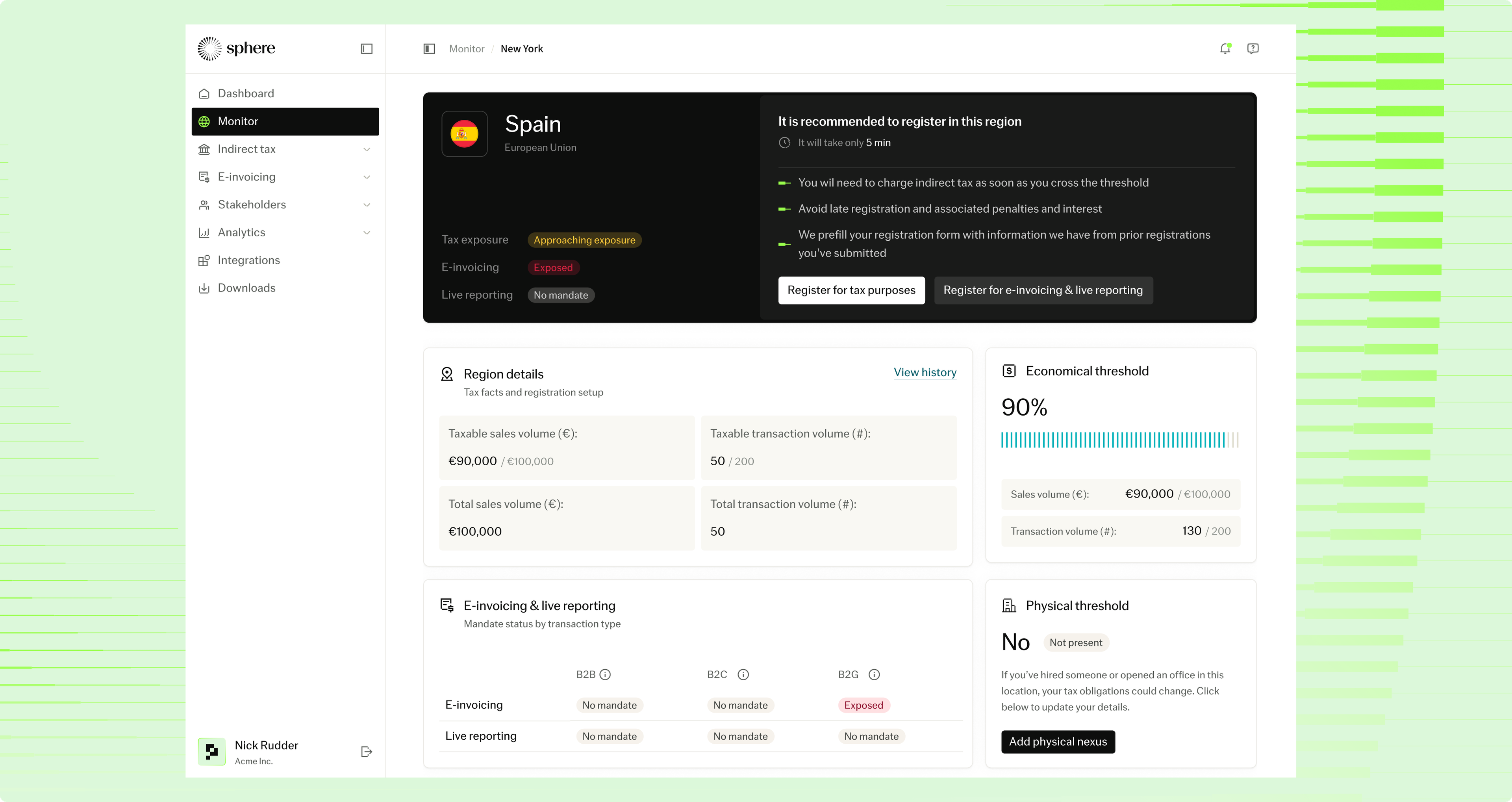
Sphere is a global indirect tax compliance platform. It handles OSS, IOSS, and any local EU registrations from one place. It monitors your thresholds and VAT number validity continuously. It also automates return preparation, filing, and remittance, with a full audit trail in place of a spreadsheet trail.
Sphere charges a flat fee per transaction, not a percentage of your revenue. Continuous monitoring means changes like the €3 duty or a new e-invoicing mandate get caught proactively, not after the fact.
Frequently asked questions

Ready to automate your EU VAT compliance?
Schedule a demo with Sphere today