Idaho Sales Tax: Rates, Rules & Filing Guide

Idaho Sales Tax: Rates, Rules & Filing Guide | |
|---|---|
Idaho sales tax rate: | 6% |
Max combined state and local sales tax rate: | 9% |
Economic nexus threshold: | $100,000 in gross sales in the previous or current calendar year |
What sales count toward the threshold: | Gross sales, including marketplace sales |
Tax authority: | |
Tax portal: | |
SaaS taxable: | No |
Administration difficulty: | 2/5 |
Idaho sales tax is a flat 6% stateside rate administered by the Idaho Tax Commission. A handful of resort cities like Sun Valley, Ketchum, and McCall add voter-approved local option taxes of up to 3%, pushing the combined sales tax rate as high as 9% in those hot spots. SaaS and electronically delivered software are not taxable in Idaho, but prewritten software delivered on physical media such as a disc or hard drive is taxable, and so are digital products sold with permanent use rights (such as download movies, music, or eBooks).
This Idaho sales tax guide covers taxability rules, economic nexus thresholds, registration, filing, and remittance from start to finish.
Idaho Sales Tax at a Glance
Idaho charges a 6% flat sales and use tax rate with no general local add-ons in most of the state. This makes Idaho one of the simpler states when it comes to sales tax compliance. There are no county or city sales taxes and no sales tax holidays to track.
The exception is Idaho’s resort cities. Cities like Sun Valley, Ketchum, McCall, and Sandpoint can levy a local option tax of up to 3% on top of the state rate. In Sun Valley, that brings the combined sales tax rate to 9%. Each resort city also decides what its local tax applies to. Some tax everything the state taxes. Others limit their tax to lodging, restaurant food, and alcohol by the drink.
Idaho uses destination-based sales tax sourcing. The rate you charge is based on the buyer's delivery address, not your business location. Everything is administered through the Idaho Taxpayer Access Point (TAP). Note that Idaho is not a member of the Streamlined Sales Tax (SST) program, so remote sellers must register directly with the Idaho State Tax Commission rather than through the SST central registration system.
Taxable Categories: What Idaho Sales Tax Applies To
Idaho sales tax applies to retail sales of tangible personal property and a short list of taxable services, such as admissions, hotel accommodations, and equipment rentals. Here is how the main product categories break down.
Tangible Personal Property (TPP)
Tangible personal property is taxable in Idaho at the 6% rate, plus any applicable resort city local option tax. If you sell physical goods at retail, assume they are taxable unless a specific exemption applies. Clothing is taxable in Idaho, which surprises sellers coming from states like Minnesota or Pennsylvania that exempt it.
Delivery and shipping and handling charges are not taxable in Idaho when they are separately stated on the invoice. Bundle them into the product price, though, and the full amount becomes taxable.
If you buy goods for resale, you can purchase them tax free by giving your supplier a completed resale certificate (Idaho Form ST-101). The same form works as an exemption certificate for exempt buyers like government agencies and qualifying nonprofits. Be sure to keep every certificate on file, because the Idaho State Tax Commission can ask for them during an audit.
SaaS and Digital Products
SaaS is not taxable in Idaho. The Idaho State Tax Commission does not impose sales tax when software is accessed remotely and no tangible personal property changes hands. This applies to both B2B and B2C SaaS sales. Custom software developed for a single customer is also exempt, regardless of how it is delivered.
The line to watch is delivery method. Prewritten ("canned") software delivered on tangible media like a disc or USB drive is taxable. The same canned software delivered electronically or accessed remotely is exempt.
Digital products follow a similar logic. Digital goods like music, e-books, videos, and games are taxable only when the buyer receives a permanent right to use them. Subscriptions, rentals, and streaming access without permanent rights are not taxable. So a $9.99 movie purchase the customer keeps forever is taxable, while a monthly streaming subscription is not.
One possible trap is bundled transactions. If you bundle SaaS with taxable goods and do not separately state each item on the invoice, Idaho can tax the entire bundle. Separate line items protect your exempt charges.
Sphere's tax engine classifies Idaho software and digital product transactions automatically, so the right treatment applies to every sale without manual research.
Groceries, Prescription Drugs, and Agricultural Inputs
Idaho is one of the few states that taxes groceries at the full statewide 6% rate. However, to offset that cost, Idaho residents can claim a food tax credit of $155 per person per year on their state income tax return. (This credit increased from $120 to $155 in 2025.) Residents who take the time to save receipts can actually itemize and save up to $250 per person per year.
Prescription drugs are exempt from Idaho sales tax. Agricultural inputs, including seeds, fertilizer, and livestock feed, are also exempt when used in production. These exemptions matter for retailers with mixed product catalogs, since the same checkout may include taxable groceries and exempt prescription drugs.
Monitoring: When Idaho Sales Tax Applies to You
You’re required to register for and collect Idaho sales tax once you establish sales tax nexus in the state.
Economic Nexus Threshold
Idaho's economic nexus threshold is $100,000 in gross sales into the state in the current or previous calendar year. Once you trigger a sales tax obligation, you’re required to register and begin collecting.
The threshold counts all sales, both taxable and exempt, including services. There is no transaction-count threshold, so a business with 50 large orders can hit nexus just as fast as one with 5,000 small ones. Sphere monitors your Idaho sales in real time and alerts you before you cross the line.
Physical Nexus
Any physical presence in Idaho creates physical nexus, regardless of your revenue. That includes employees, offices, inventory stored in the state, or regular in-state business activity. A single remote employee in Lewiston, Idaho is enough. Physical nexus means you must register and collect from your first taxable sale, there is no sales threshold.
Marketplace Facilitators
Marketplace facilitators like Amazon, Walmart, and Etsy must collect and remit Idaho sales tax on behalf of their sellers once the facilitator exceeds the $100,000 threshold. If you sell through a registered marketplace, do not report those sales on your own Idaho return. The facilitator reports them. Keep documentation of facilitator-collected sales, though, since you will need it if the Idaho State Tax Commission ever asks during an audit.
Registration: How to Register for Idaho Sales Tax
You need a seller's permit before you can collect Idaho sales tax. Idaho's registration process has an unusual two-step structure that trips up companies expecting a single online signup.
How to Register
Start at the Idaho Business Registration System (IBRS) and create a new account. This one application covers your seller's permit and other state registrations.
Note that processing is not immediate. It typically takes 2 to 3 weeks to get your account. Once your registration is approved, you can sign up for an Idaho Taxpayer Access Point (TAP) account. TAP then mails you a confirmation code by letter. When the code arrives, you enter it to activate your TAP account and gain full filing access. Idaho’s sales tax registration is time-consuming, so budget a month for the whole process.
Registration Fees
There is no fee to register for an Idaho seller's permit.
Idaho’s Small Seller Exemption
Idaho has a small seller sales tax exemption. Idaho residents who operate as individuals or sole-proprietors and sell less than $5,000 annually are not required to register for a sales tax permit and collect sales tax. The state has strict guidelines for who qualifies, such as that businesses who operate a storefront are not allowed to take the exception, and businesses must pay sales tax on all goods they buy for business use. If you are an Idaho resident with a very small business, you may qualify for this program.
Sphere and Registration
Sphere manages the full IBRS and TAP registration process on your behalf, including the mailed confirmation code step. You get a registered, active Idaho account without touching either portal.
Calculation: Idaho Sales Tax Rates
Because the state only levies one statewide rate, Idaho’s sales tax rates are among the easiest in the country to calculate.
State Rate
The state rate is a flat 6%, and it applies statewide with no general local sales tax rate stacked on top. The only additions are the resort city local option taxes of up to 3% in cities like Sun Valley, Ketchum, and McCall.
If you sell into those cities, confirm the current combined sales tax rate before charging customers. The Idaho State Tax Commission lists resort city contacts here, and an Idaho sales tax calculator or rate lookup tool can verify the rate for a specific delivery address.
Special Rate Items
A few categories carry special treatment:
- Groceries: taxed at the full 6% rate, offset by the $155 per person food tax credit on Idaho income tax returns
- Prescription drugs: exempt
- Agricultural inputs (seeds, fertilizer, livestock feed): exempt
Idaho also levies separate excise taxes on products like fuel, beer, wine, and tobacco. Those are distinct from sales tax and are filed on their own returns.
What the Rate Applies To
The 6% rate applies to taxable tangible personal property, canned software on physical media, digital products sold with permanent use rights, groceries, clothing, and taxable services. SaaS is excluded. Idaho uses destination-based sourcing, and all sellers, whether in-state or remote, charge the rate in effect at the buyer's delivery address.
Filing: How and When to File Idaho Sales Tax Returns
Idaho sales tax returns are filed electronically through TAP using Form 850. Your filing frequency and due dates depend on how much tax you owe.
Filing via Idaho TAP
All returns are filed through the Idaho Taxpayer Access Point. The Idaho State Tax Commission has stopped mailing personalized paper returns, so TAP is now the standard route.
You must file a return for every period while your permit is active, even a zero return with no sales. Skip this and penalties can apply. It’s important to note that if you report $0 in sales for 12 months in a row, the state cancels your permit and you’ll have to reapply should you start selling again.
Filing Deadlines
Idaho returns are due on the 20th day of the month after the reporting period ends:
- Monthly filers: due the 20th of the following month. I.e. July sales tax is due August 20.
- Quarterly filers: due within 20 days after the quarter ends.
- Semiannual filers: due July 20 and January 20.
- Annual filers: due January 20.
If the 20th falls on a weekend or holiday, the return and payment are due the next business day.
Filing Frequency Thresholds
The Idaho State Tax Commission assigns your filing frequency based on sales volume:
- Monthly filing is the default. Most retailers file monthly, and new businesses typically start at that frequency.
- Quarterly filing is available to retailers owing less than $750 in tax per quarter.
- Semiannual or annual filing is available by application to distributors or wholesalers with only a few sales.
Late Filing Penalties
Idaho's late sales tax filing and payment penalties are straightforward:
- Failure to file on time: 5% of the tax due per month late, up to a maximum of 25%
- Filing on time but not paying: 0.5% of the tax due per month, up to 25%
- Interest accrues on overdue tax from the original due date until paid, at the annual rate published by the Idaho State Tax Commission
The minimum penalty is $10, and even one day late triggers a full month of penalty. No penalty applies if no tax is due.
Remittance: How to Pay Idaho Sales Tax
Idaho sales tax payments are made electronically through TAP, usually at the same time you file.
Remittance via Idaho TAP
The standard Idaho sales tax payment method is ACH debit from a US bank account. You enter your bank details in TAP, and Idaho pulls the payment when you file. TAP's QuickPay option is also available for one-time payments on regular accounts.
Remittance for Foreign Businesses
No US bank account? This is where many foreign sellers get stuck, since TAP's ACH debit requires a domestic account. Sphere's embedded remittance platform pays the Idaho State Tax Commission on your behalf, so foreign businesses can stay compliant without opening a US bank account.
How Sphere Helps With Idaho Sales Tax Compliance
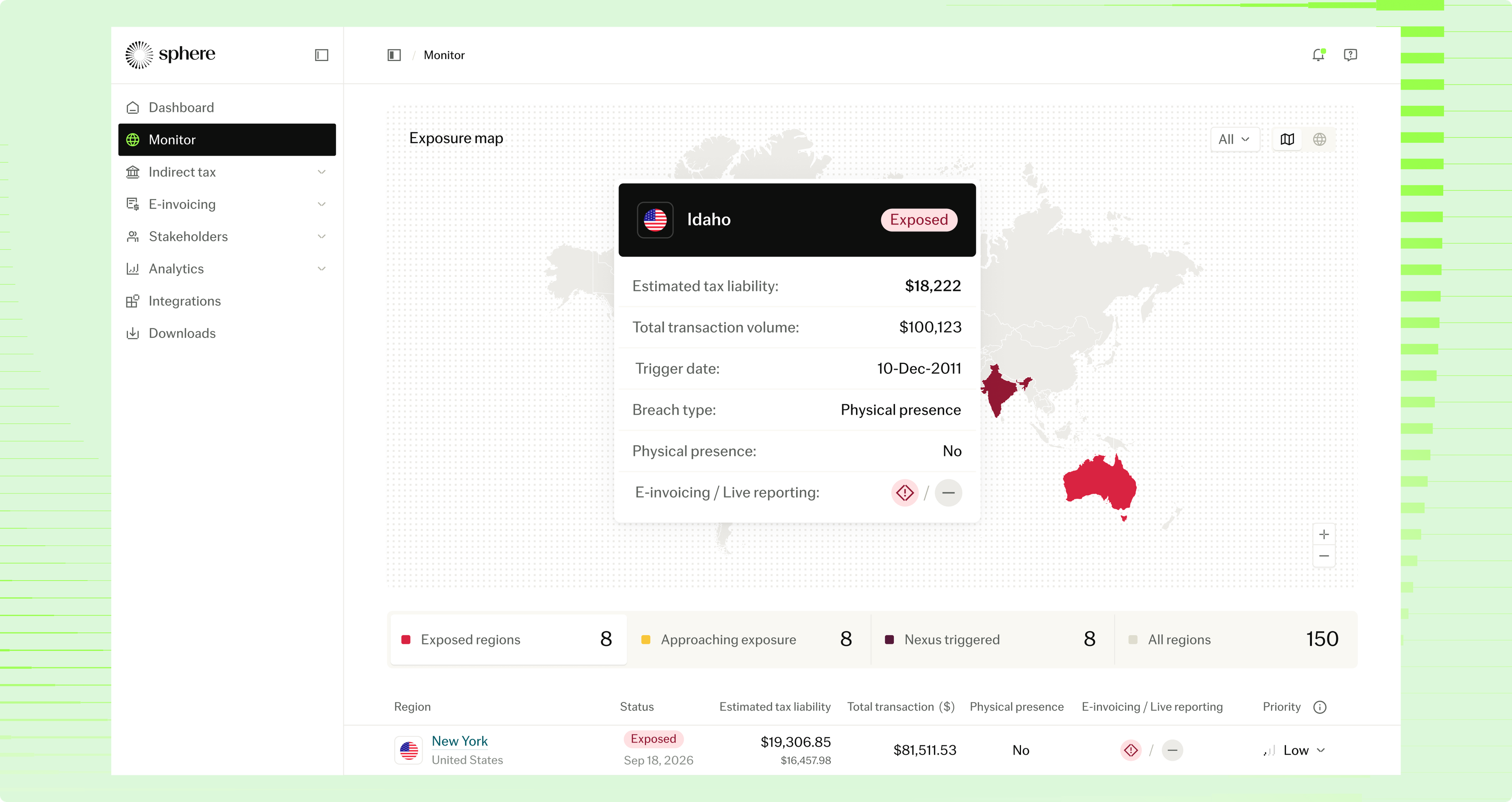
Sphere automates every step of Idaho sales tax compliance in one platform:
- Monitors your Idaho economic nexus exposure and triggers registration when you approach the $100,000 threshold
- Manages the two-step IBRS and TAP registration process, including the mailed confirmation code
- Classifies SaaS, software, and digital product transactions correctly under Idaho's delivery-based rules
- Calculates the correct rate on every sale, including resort city local option taxes
- Files Form 850 returns on schedule, including required zero returns
- Remits payments via TAP, with embedded remittance for foreign businesses without a US bank account
- Manages exemption certificate and resale certificate collection and storage for Idaho B2B transactions

Ready to automate Idaho sales tax compliance?
Schedule a demo with Sphere today.