5 Best Indirect Tax Software: A Complete Buyer's Guide

Indirect tax software automates the calculation, collection, filing, and remittance of sales tax, VAT, GST, and other transaction-based taxes. It replaces manual rate lookups, spreadsheets, and scattered compliance workflows with one system.
The five best indirect tax software platforms in 2026 are Sphere, Vertex, Sovos, Stripe Tax, and Numeral. But these tools are not interchangeable. Some only calculate tax. Others handle the full compliance lifecycle, from registration to remittance. This guide breaks down what each tool covers, what it costs, and which one fits your business now and as you grow.
Best Indirect Tax Software at a Glance
The table below compares the five best indirect tax software platforms by scope, reach, pricing, and integrations.
Tool | Best for | Service scope | Geographic reach | Pricing model | Primary integrations |
|---|---|---|---|---|---|
Sphere | US sales tax, VAT/GST, input tax, and e-invoicing in one platform | Full end-to-end: registration, calculation, filing, remittance | US + global | Flat fee per jurisdiction ($100/month) | Stripe, Chargebee, NetSuite, QuickBooks, Xero, Zuora; API-first |
Vertex | Large enterprises with ERP-centric tax teams | Determination, plus returns and e-invoicing modules | 19,000+ jurisdictions worldwide | Custom; approximately $40K to $100K+ per year for mid-market | SAP, Oracle, NetSuite, Workday, Coupa, Shopify |
Sovos | Global VAT, e-invoicing, and LATAM/EU CTC mandates | Determination, filing, and reporting | 185+ countries | Custom; enterprise-tier | 70+ ERP and transaction systems |
Stripe Tax | Businesses that bill through Stripe | Calculation (filing via paid Tax Complete add-on) | 100+ countries | 0.5% of taxed volume (no-code) or $0.50 per API transaction | Stripe-native |
Numeral | US e-commerce and SaaS sellers | Calculation, registration, filing, remittance | US-first; advertises VAT/GST in 90+ countries | $150 per state registration + $75 per filing | Shopify, Stripe, QuickBooks, NetSuite |
What Is Indirect Tax Software?
Indirect tax software is a tool that calculates and collects consumption taxes like sales tax, VAT or GST on your sales. Depending on the vendor, it also registers your business with tax authorities, files returns, and remits the tax you collected. Indirect tax software can cover US sales tax, VAT, GST, and sometimes excise tax and e-invoicing. Most modern tools are cloud-based solutions that connect to your billing system, ERP, or e-commerce platforms through APIs.
Indirect tax is different from direct tax. Direct taxes, like corporate income tax, are based on your profit. Indirect taxes are based on individual transactions. Your customer pays the tax, and you collect it and send it to the government.
This guide compares five tools: Sphere, Vertex, Sovos, Stripe Tax, and Numeral.
Why Manual Indirect Tax Compliance Doesn’t Work
Manual indirect tax compliance breaks down as soon as you sell into more than a few jurisdictions. Tax rates change constantly. Filing dates vary by jurisdiction. Jurisdictions tax different products and services differently. And what even creates sales tax nexus (i.e. the requirement to collect indirect tax) changes depending on the state or country where you’re doing business.
For example, since the 2018 South Dakota v. Wayfair Supreme Court case, US states can require you to collect sales tax based on sales volume alone. That means you can owe tax in a state where you have no office, employees, or inventory. Many businesses don't notice until they have already crossed a threshold and are required to collect the tax.
Around the world, most countries have VAT or GST as their indirect tax. Each one has its own rates, registration thresholds, and filing rules. And 2026 brings one of the largest waves of e-invoicing and continuous transaction control (CTC) mandates yet. Belgium, Poland, and France all launched or expanded B2B e-invoicing requirements this year. These mandates are extra work on top of your periodic indirect tax filing and payment requirements.
For a deeper look at what global compliance requires, see our guide to international tax compliance software.
Calculation vs. Full Compliance: What Does the Software Actually Handle?
The most important question to ask about any indirect tax software is whether it calculates tax only or handles full compliance. Calculation-only tools figure out the right amount of tax at checkout or on an invoice. Full compliance tools also register you, file your returns, and remit payment to each tax authority.
With calculation-only tools, filing and remittance is a separate step. Sometimes it's a paid add-on. Sometimes it's handled by an outside partner. Sometimes it isn't offered at all.
Stripe Tax is a good example. Its base product calculates and collects tax. To have returns filed and tax remitted, you need a separate Tax Complete subscription. Stripe then hands US filing off to TaxJar, but even that is US filing only.
This is one of the most common points of confusion we see at Sphere. A business assumes its calculation tool is "handling sales tax." Months later, it discovers that no one has actually been filing the returns. By then, penalties and interest may already be adding up.
The same gap shows up with tax reporting and tax return preparation. A tool that calculates tax well may still leave you to build the returns yourself. And returns can get complicated, requiring you to determine how much tax you collected in each city, county, and special taxing district in a US state, for example.
Before you compare any tools, answer this question first: do you need calculation only, or do you also need registration, filing, and remittance?
Types of Indirect Tax Software
Indirect tax software falls into five main categories. Each one fits a different stage of growth and level of complexity.
- Manual or in-house. You register and file directly with each tax authority, or your team builds tax logic into your billing system. Due to indirect tax’s complexity, this works only at a very small scale.
- Native to a billing or payments platform. Stripe Tax and Shopify Tax fall into this group. These tools are calculation-focused and tied to one platform. They’re mainly for single-channel sellers with little tax complexity.
- Traditional tax engines. Vertex, Sovos, Avalara, and Thomson Reuters ONESOURCE fall into this group. They are built around determination matrices that research teams maintain by hand. Most are strongest in US and domestic coverage and are designed to plug into large ERP systems. These are the legacy tax engines.
- Newer SaaS-focused entrants. Numeral falls into this group. These tools were built with subscription billing models in mind.
- AI-native platforms. Sphere falls into this group. It is global by default rather than US-first, and it covers registration through remittance in one system.
5 Best Indirect Tax Software Platforms Compared
The five best indirect tax software platforms are Sphere, Vertex, Sovos, Stripe Tax, and Numeral. Here's how each one compares on scope, integrations, filing, and pricing.
1. Sphere
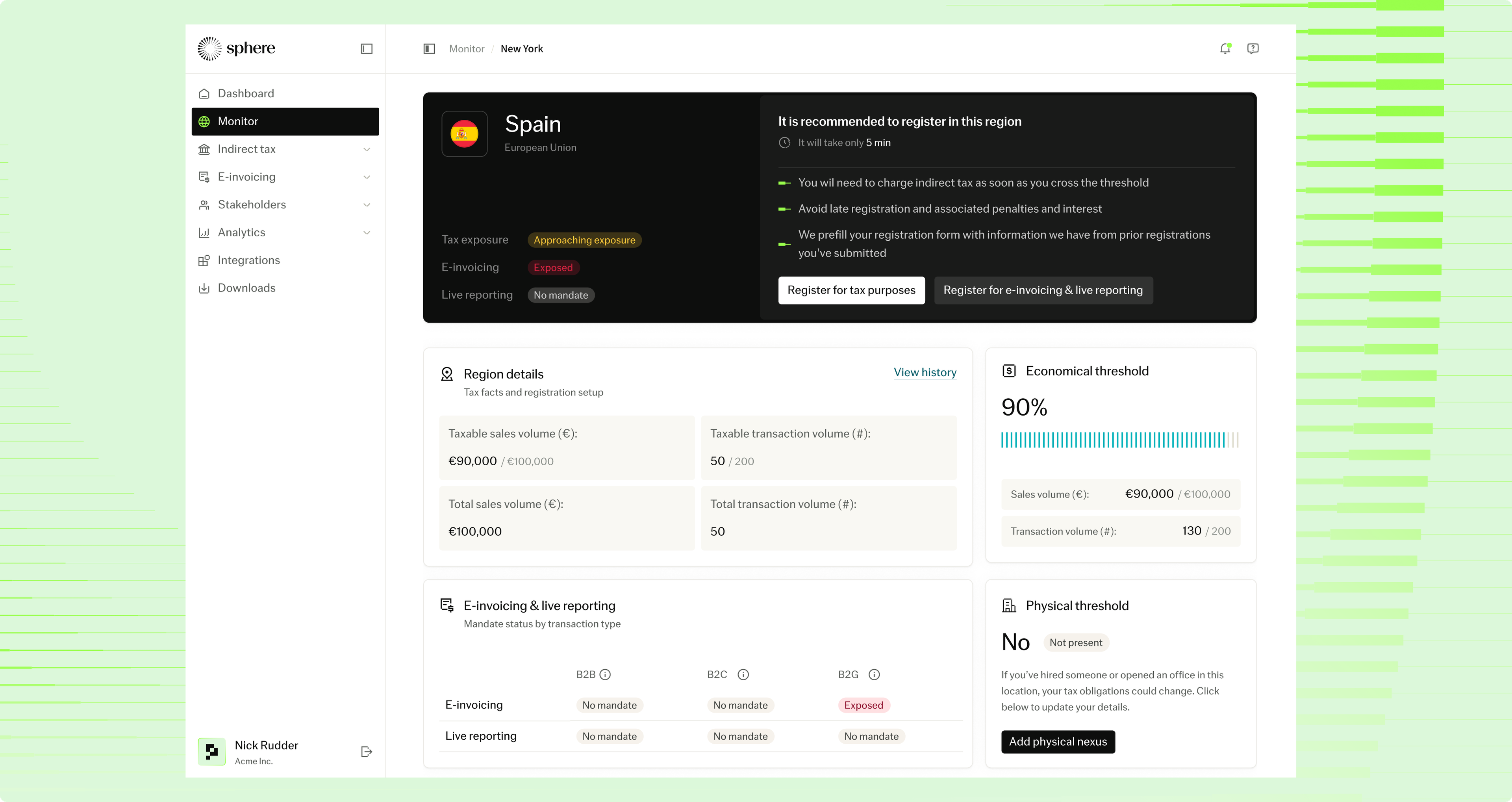
Sphere is an AI-native indirect tax platform built for global businesses. It handles sales tax, VAT, GST, input tax, withholding tax, digital services tax (DST), and e-invoicing in one system. At its core is the Tax Review and Assessment Model (TRAM), a tax-focused large language model trained to read and apply tax law across jurisdictions.
Best for: Growing companies that need sales tax automation in the US and global tax compliance internationally, or plan to. Sphere fits businesses that want one vendor for life instead of a patchwork of tools.
Determination scope: TRAM monitors tax law around the world and applies the right tax treatment to each transaction. Sphere's AI also reviews your product catalog and suggests the right tax codes across jurisdictions. This cuts down on manual classification errors.
Integration coverage: Sphere offers prebuilt connectors for Stripe, Chargebee, NetSuite, QuickBooks, Xero, Zuora, Maxio, Orb, PayPal, and more. It is also API-first, so teams can connect custom billing systems and e-commerce platforms.
Filing and managed service offerings: Sphere covers the full lifecycle. It monitors nexus in real time, handles registrations, calculates tax, files returns, and remits payment. It connects directly with tax authorities instead of relying on a network of third-party partners.
Pricing: Sphere charges a flat fee of $100 per jurisdiction per month for businesses registered in fewer than 10 jurisdictions (up to 50,000 transactions). There are no usage fees, no overages, and no long-term contracts. Your cost stays predictable as your sales volume grows.
Limitations: Sphere is a newer company than legacy providers like Vertex. Enterprises that have spent years customizing a traditional engine inside SAP may face a bigger migration project.
2. Vertex
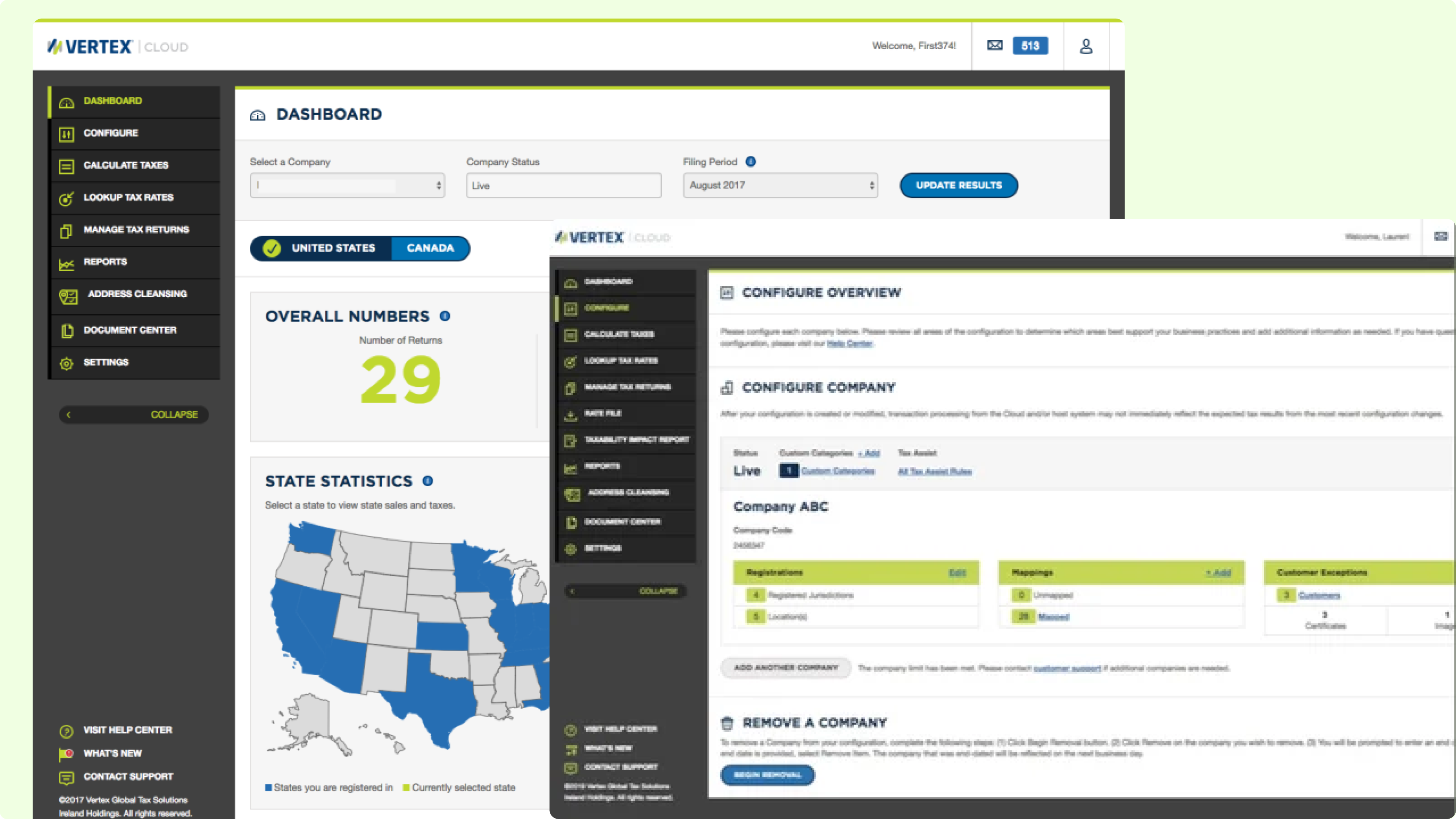
Vertex is one of the oldest names in indirect tax software. Its O Series tax engine keeps tax rules for more than 19,000 jurisdictions worldwide. Vertex also offers e-invoicing tools and has begun adding AI features, like Smart Categorization.
Best for: Large enterprises with dedicated in-house tax teams and complex ERP environments.
Determination scope: Vertex relies on its tax research team to build and update its tax content. It supports sales and use tax, VAT, and industry-specific content for sectors like telecom, leasing, and manufacturing.
Integration coverage: Vertex integrates deeply with SAP, Oracle, NetSuite, Workday, Coupa, and Shopify.
Filing and managed service offerings: Filing is handled through a separate returns module. Registration and full managed services are not part of the core engine.
Pricing: Vertex does not publish pricing. According to Vendr, mid-market deals typically fall between $40,000 and $100,000 per year. Vertex reported an average annual revenue per direct customer of $137,867 at the end of 2025.
Limitations: Implementation often takes months and may require outside consultants. The cost is hard to justify for mid-size businesses.
3. Sovos
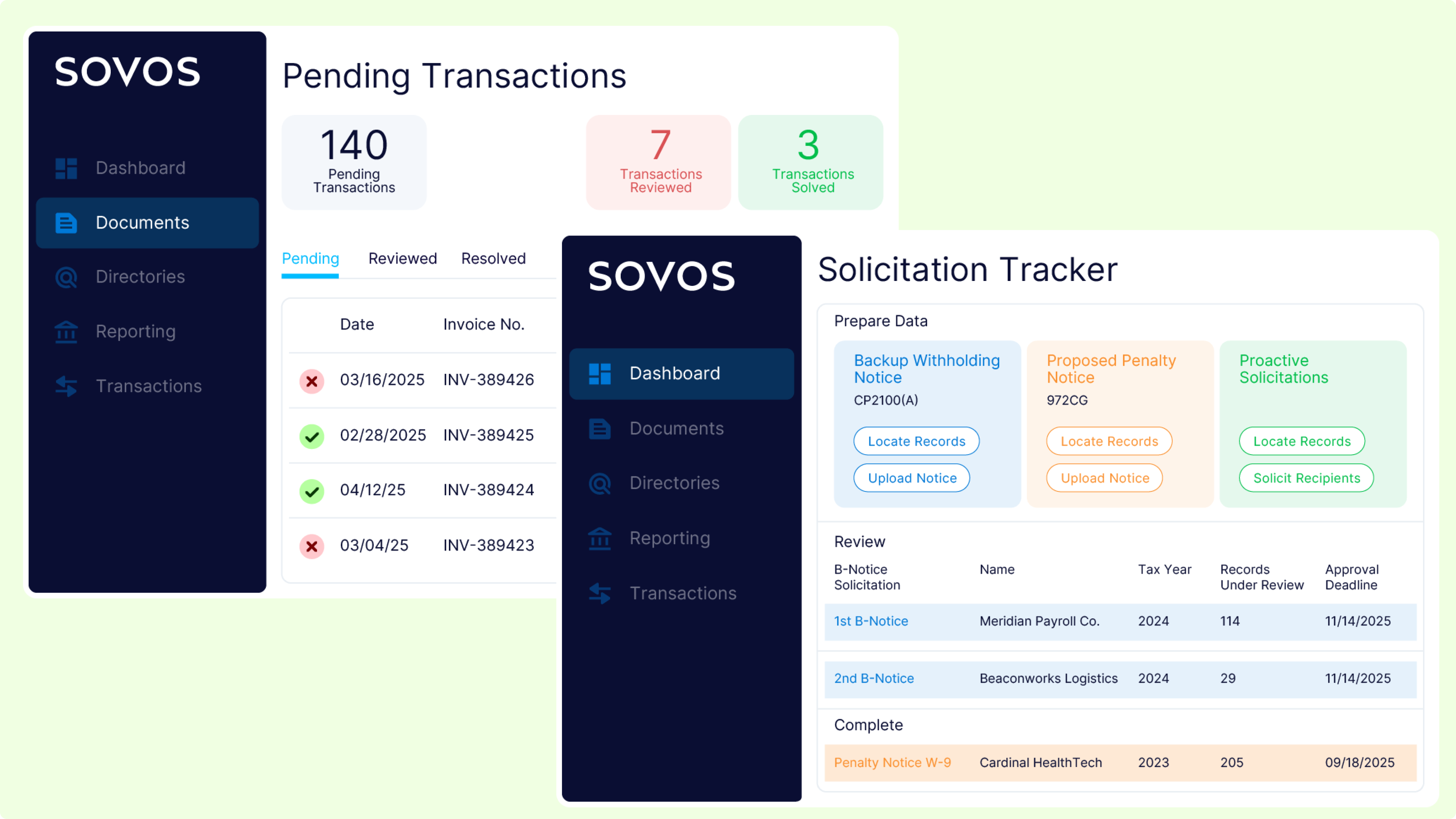
Sovos is a global tax compliance provider with a strong focus on e-invoicing and continuous transaction controls. Its Indirect Tax Suite covers tax determination, e-invoicing, and periodic reporting.
Best for: Multinational companies facing e-invoicing and CTC mandates in Latin America and the EU.
Determination scope: Sovos markets its engine as Global Tax Determination. It provides real-time tax calculations for sales and use tax, VAT, and GST across 185+ countries. Its e-invoicing tools cover 60+ countries.
Integration coverage: Sovos connects with more than 70 ERP and transaction management systems, with especially strong SAP support.
Filing and managed service offerings: Sovos offers sales tax and VAT filing, plus SAF-T and other digital reporting.
Pricing: Pricing is custom and enterprise-tier. Sovos does not publish rates.
Limitations: Sovos is built for large multinationals. Its products are modular, so some teams find the experience fragmented across different portals.
4. Stripe Tax
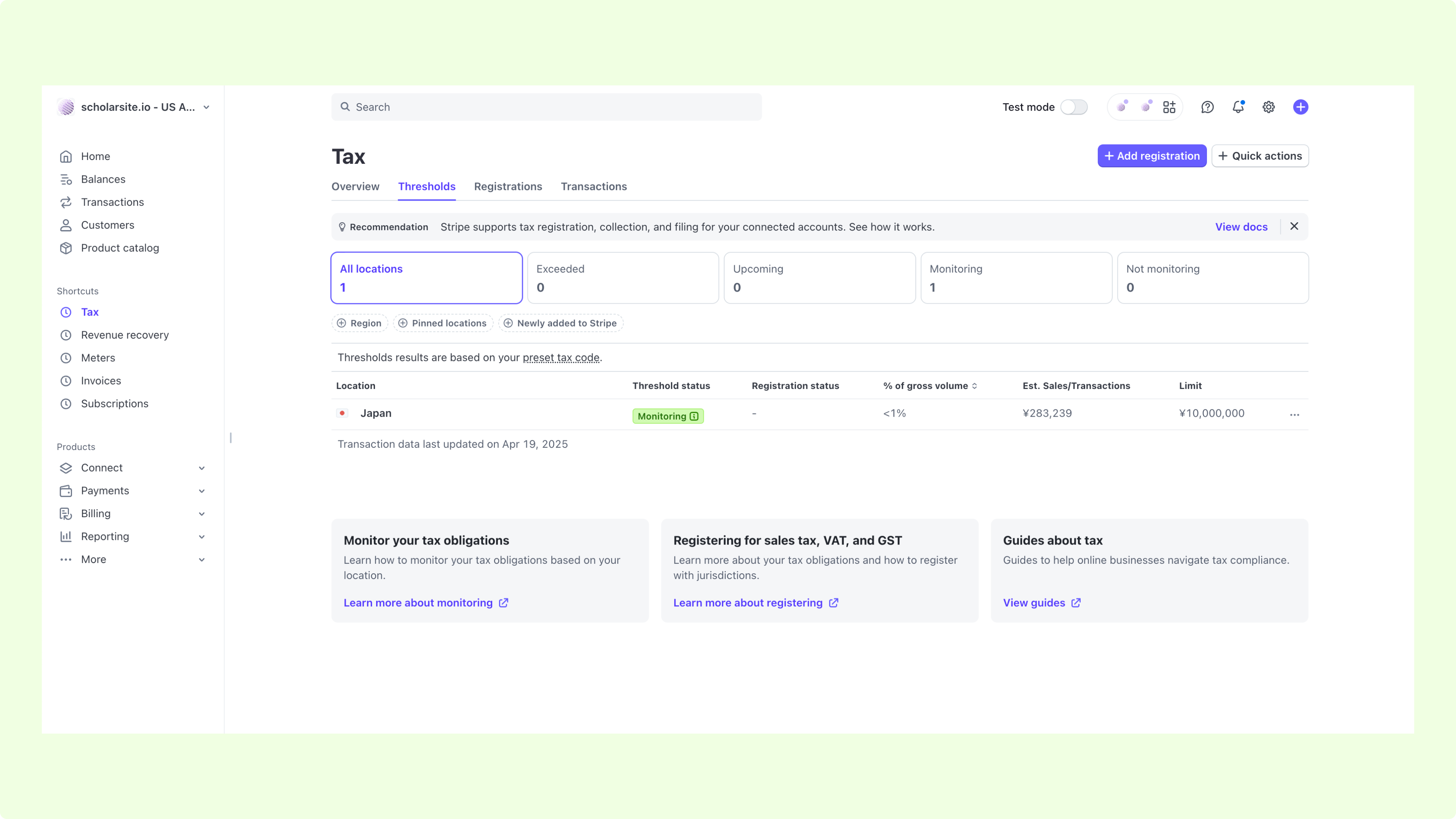
Stripe Tax is the tax feature built into Stripe's payments and billing platform. It calculates and collects tax across 100+ countries.
Best for: Businesses that already run their billing and payments through Stripe.
Determination scope: Stripe Tax calculates tax at checkout and on invoices. It also monitors registration thresholds based on your Stripe transactions. In some countries, it only calculates tax for digital products sold by remote sellers.
Integration coverage: Stripe Tax is Stripe-native. It can calculate tax for outside transactions through its API, but it works best inside the Stripe ecosystem.
Filing and managed service offerings: Filing is not included in the base product. You need a Tax Complete subscription, which starts at $90 per month for four filings per year. US returns are filed through TaxJar. International filings run through partners.
Pricing: Pay-as-you-go pricing is 0.5% of volume in jurisdictions where you're registered, or $0.50 per API transaction. That volume includes the tax itself. Tax Complete adds a subscription fee and per-filing overages.
Limitations: Percentage-based pricing grows as your revenue grows. Filing depends on partners, and you need a US bank account for TaxJar to remit US sales tax.
5. Numeral
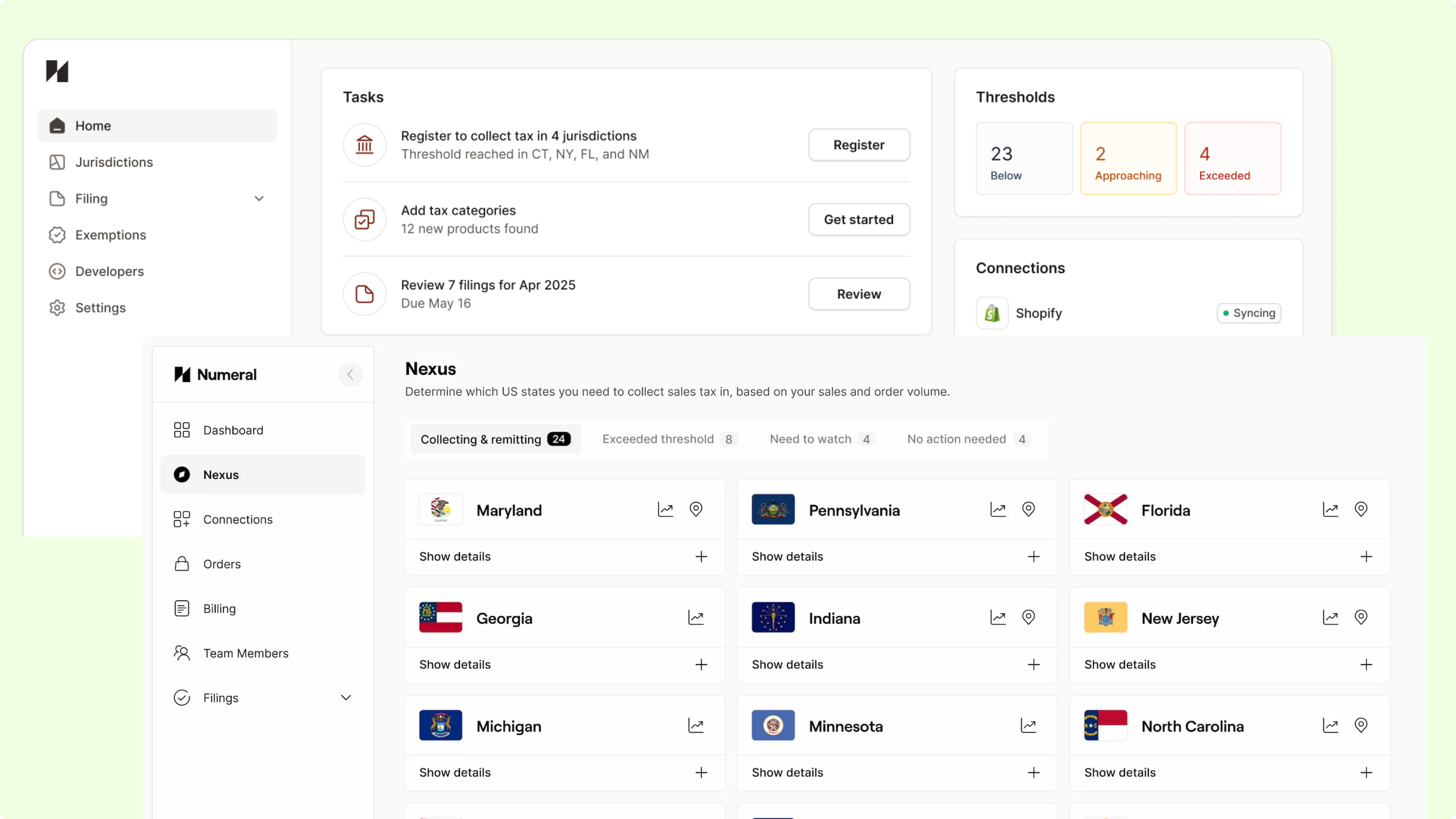
Numeral is a sales tax compliance platform for e-commerce and SaaS sellers. It automates registration, filing, and remittance.
Best for: US-based e-commerce brands and smaller software companies that want simple, predictable US sales tax compliance.
Determination scope: Numeral calculates sales tax and monitors economic nexus thresholds. It also advertises VAT and GST coverage in 90+ countries. Its strength remains US sales tax.
Integration coverage: Numeral connects with Shopify, Stripe, QuickBooks, and NetSuite.
Filing and managed service offerings: Numeral handles registrations and filings for you. Its Professional plan adds exemption certificate management. It guarantees on-time filing and pays penalties and interest if it misses a deadline.
Pricing: Numeral charges $150 per state registration and $75 per filing. Enterprise pricing is custom.
Limitations: Per-filing costs add up as you register in more states. A business filing monthly in many states can end up paying for hundreds of returns a year.
Build Tax Compliance In-House or Use Software?
For most businesses, buying indirect tax software makes more sense than building it. Some finance and engineering teams consider building tax logic into their own billing system, especially if they already rely heavily on one platform. In practice, this rarely holds up past a handful of jurisdictions.
The issue is maintenance. Tax rates, thresholds, and product taxability rules change all the time. A single state can change how it taxes software or digital goods with only a few months' notice. An in-house build isn't a one-time cost. It's an ongoing commitment to track every law change, forever.
At Sphere, we often see companies raise the in-house option early on. Most land on buying once they price out what continuous maintenance would actually take.
Traditional Tax Engines vs. AI-Native Tax Platforms
The main difference between traditional tax engines and AI-native platforms like Sphere is how they keep tax determinations current as rules change. That difference affects ongoing maintenance, compliance coverage, and how well the tool scales.
Traditional engines (Vertex, Sovos, Avalara) | Sphere | |
|---|---|---|
How determinations stay current | Tax matrices built and maintained by hand, reviewed periodically by research teams | AI reads and monitors tax law directly to create and update determinations |
Scope | Often calculation-focused, with registration and filing handled separately or by a third party | Registration, calculation, filing, and remittance in one system |
Coverage | Strong in the US; international coverage and e-invoicing vary by vendor | Global coverage, including VAT/GST and e-invoicing, built international-first |
Pricing | Typically percentage-of-revenue, tiered, or seat-based | Flat fee per jurisdiction |
Here's what those differences mean for your business:
- More accurate determinations. A matrix maintained by hand forces research teams to simplify rules so the workload stays manageable. An AI-native system doesn't have to make the same tradeoffs, so it can capture more detail, ensuring you charge the right amount of sales tax on the right product every time.
- Coverage that scales. Sphere covers new regions, product categories, and tax types without waiting on a research team to catch up. Rules are monitored continuously instead of checked and caught after the fact, when you may already owe a penalty.
- One system instead of three. You don't need to stitch together a calculation tool, a filing service, and manual registrations. It just works.
- Predictable cost. A flat fee per jurisdiction doesn't rise with your revenue.
- The broadest tax coverage available. Sphere covers sales tax, VAT, GST, input tax, and e-invoicing, with digital service tax (DST), withholding tax, tariffs and customs coming next. No other platform on the market covers this range in one system.
It's important to note that growing businesses usually need these extra services sooner than they expect. Choosing the most complete provider now helps you avoid a painful migration later.
How to Choose the Right Indirect Tax Software
The right indirect tax software depends on seven factors: scope, integrations, jurisdiction coverage, pricing, historical exposure, extra features, and support. Ask every vendor these questions before you sign:
- Does it calculate only, or does it also register, file, and remit? I.e., what does the tool actually do for you?
- Does it integrate directly with your billing system or ERP? A vendor without your integration is a dealbreaker, no matter how deep its features are.
- Does it cover the jurisdictions you sell into today and the ones you'll expand into next? Look for international VAT/GST and e-invoicing, not just US sales tax.
- How is it priced? Compare flat fees, percentage of revenue, and seat or tier-based models. Then estimate how each one scales as your volume grows.
- Can it handle historical exposure? If you're switching after finding a gap, you may need a Voluntary Disclosure Agreement (VDA) or back-filing.
- Does it cover the extras you'll need? B2B sellers need exemption certificate management to track tax-exempt customers.
- What's the support model? Find out whether you'll get self-serve documentation, an account team, or direct access, like a shared Slack channel, when something changes at tax time or a filing looks wrong.

Ready to manage US sales tax, VAT, input tax, and e-invoicing in one platform?
Schedule a demo with Sphere today