Iowa Sales Tax: Rates, Rules & Compliance Guide


Iowa Sales Tax Quick Facts | |
|---|---|
Iowa sales tax rate: | 6% (7% in most localities) |
Max combined state sales tax rate: | 7% |
Economic nexus threshold: | $100,000 or more in gross sales in the current or immediately preceding calendar year |
What sales count toward the threshold: | Gross sales, including marketplace sales |
Tax authority: | |
Tax portal: | |
SaaS taxable: | B2C SaaS is taxable, B2B SaaS is nontaxable |
Administration difficulty: | 2/5 |
Iowa charges a 6% state sales tax, and most cities and counties add a 1% local option sales tax on top of it, which brings the combined rate to 7% in most of the state.
Iowa is different from most other states if you sell software as a service (SaaS) in that how it’s taxed depends on the customer. The state considers SaaS sold to individual consumers as taxable but SaaS sold to businesses as nontaxable. It’s vital for SaaS businesses to account for this distinction.
This Iowa sales tax guide covers what’s taxable, how to figure out if you have nexus, how to register, how to calculate the right rate, and how to file and remit what you collect.
Iowa Sales Tax at a Glance
Iowa's state sales and use tax rate is 6%. On top of that, most jurisdictions in the state impose a 1% local option sales tax (LOST), which brings the typical combined rate to 7%. That 7% figure is also the ceiling, with no Iowa jurisdictions charging more than that in standard sales tax.
Before you charge 7% on all sales to Iowa though, note that not all jurisdictions buy into the LOST, so a small number of them still only have the 6% sales tax rate.
Iowa uses destination-based sourcing. That means sales tax is charged at the rate at the buyer’s delivery address. Use the Iowa sales tax calculator tool to confirm rates if you are charging manually.
Iowa sales tax is administered through GovConnectIowa, the state's online tax portal. You'll use it to register, file returns, and remit payment.
Taxable Categories: What Iowa Sales Tax Applies To
SaaS and Digital Products
SaaS is taxable in Iowa when sold to consumers and nontaxable when sold to businesses for exclusive business use.
Effective January 1, 2019, Iowa began taxing prewritten computer software and specified digital products, delivered electronically or otherwise. Since SaaS is delivered access to prewritten software, it’s taxable under this rule.
But Iowa also created a commercial enterprise exemption effective the same date. If you sell SaaS to a for-profit business, insurance company, or financial institution, and that buyer uses the software exclusively for business purposes, the sale is exempt. Nonprofits generally don't qualify for this exemption, with limited exceptions for nonprofit insurers and financial institutions. If a business's use of your software is more than minimally for personal or non-business purposes, the exemption doesn't apply.
If you sell SaaS, this means you need to not only track the sales tax rate at your buyer’s location, but your customer’s type. Are they a consumer or a business? Sphere's tax engine classifies Iowa transactions by customer type automatically, so you don't have to build that logic yourself.
Infrastructure as a service (IaaS) and web hosting are not taxable in Iowa. Iowa's law only reaches software as a service specifically, so cloud infrastructure and hosting fall outside the tax base. Internet access charges are also exempt, since federal law prohibits states from taxing internet access.
Tangible Personal Property (TPP)
Physical goods sold in Iowa are taxed at the combined state and local rate that applies at the delivery address. Groceries (unprepared food for home consumption) and most prescription drugs are not considered taxable goods and are exempt from Iowa sales tax. Prepared and hot foods are taxable.
Taxable Services
Unlike tangible personal property, which is taxable unless specifically exempted, services in Iowa are only taxable if the law specifically names them. Iowa's list runs to roughly 75 enumerated services. Most professional services, like legal, accounting, and consulting work, are not on that list and stay exempt.
Services that are taxable in Iowa include:
- lawn care and landscaping
- pet grooming
- vehicle repair
- information services
- communication services
- carpentry
- electrical work
- laundry and dry cleaning
- admission to athletic events
If you're not sure whether a specific service you provide is on Iowa's list, check Iowa Code section 423.2(6) for a full list.
Monitoring: When Iowa Sales Tax Applies to You
You’re required to collect sales tax in Iowa when your business has sales tax nexus in the state. Several factors can trigger nexus.
Economic Nexus Threshold
You have economic nexus in Iowa once your gross revenue from sales into the state hits $100,000 in the current or prior calendar year. Having economic nexus as a remote (out-of-state) seller means that you must register for an Iowa sales tax permit and collect sales tax from your Iowa customers.
Iowa counts both taxable and exempt sales toward that $100,000 threshold, but exempt services don't count. There's no separate transaction-count threshold in Iowa. Some other states still use a 200-transaction trigger alongside their revenue threshold, but Iowa no longer takes that approach.
Sphere monitors your Iowa sales in real time and flags you when you're approaching the threshold, so you're not caught registering late.
Physical Nexus
Any physical presence in Iowa creates nexus, regardless of your revenue. That includes an office, a warehouse, an employee, or inventory stored in the state, including even a single item sitting in a third-party fulfillment center.
Marketplace Facilitators
If you sell exclusively through a marketplace facilitator like Amazon or Etsy, the marketplace generally collects and remits Iowa sales tax on your behalf. You may not need a separate Iowa permit for marketplace-only sales, but confirm your specific situation with the Iowa Department of Revenue, since combining marketplace and direct sales from your own store or website can change what you owe.
Registration: How to Register for Iowa Sales Tax
How to Register
Registering for an Iowa sales tax permit is straightforward and free.
- Go to GovConnectIowa
- Click "Register a New Business"
- Select "Sales Tax Permit" and complete the application
Processing is immediate. Once you submit your application, your permit is issued right away, so you can start collecting tax
Registration Fees
There's no fee to register for an Iowa sales tax permit. If you'd rather not handle the registration yourself, Sphere can manage the entire GovConnectIowa registration process on your behalf.
Calculation: Iowa Sales Tax Rates
State and Local Rate
Iowa's rate structure is one of the simpler ones among states with local option taxes. You're working with one of two numbers: either the 6% state rate, or the 7% total rate when localities opt to add the 1% in local option sales tax (LOST).
Most areas in Iowa have the 7% LOST sales tax rate, but don’t assume all will. LOST is voter-approved and some localities have not added the extra 1%, meaning their sales tax rate stays at the 6% Iowa state base rate. Use the Iowa Department of Revenue’s sales tax lookup tool to calculate Iowa sales tax if you are charging manually.
What the Rate Applies To
The rate you calculate applies to taxable tangible personal property, B2C SaaS, and Iowa's enumerated taxable services. B2B SaaS sold to a qualifying commercial enterprise and IaaS are non-taxable. Because Iowa uses destination-based sourcing, always charge the sales tax rate at the buyer’s delivery address.
Groceries and most prescription drugs are exempt from Iowa sales tax regardless of delivery address, so those items don't get a rate applied at all.
Shipping charges are generally not taxable in Iowa if they are separately stated on the invoice.
Filing: How and When to File Iowa Sales Tax Returns
Filing via GovConnectIowa
File your Iowa sales and use tax returns through GovConnectIowa. Be sure to file even if you don’t have any tax due. Zero returns are required for all periods and you’ll be subject to fines and penalties if you miss a filing.
Filing Deadlines
Monthly filers must file and pay by the last day of the month immediately following the reporting period. Annual filers have until January 31 of the following year. If a due date falls on a weekend or state holiday, the deadline moves to the next business day.
Filing Frequency Thresholds
Iowa sets your filing frequency based on how much sales and use tax you collect in a year.
Filing frequency | Annual tax collected | Due date |
|---|---|---|
Monthly | $1,200 or more per year | Last day of the month following the reporting period |
Annual | Less than $1,200 per year | January 31 of the following year |
Iowa doesn't have a quarterly filing option for sales tax. Quarterly filing exists for withholding tax, but sales and use tax returns are either monthly or annual. If your collections fall under the $1,200 threshold, you can request to file annually instead of monthly. If you're over that threshold, monthly filing is required, and all monthly filers must file and pay electronically through GovConnectIowa.
Late Filing Penalties
If you file your Iowa sales tax return late, the state adds a 5% penalty on the unpaid tax. If you file on time but pay late, a separate 5% penalty applies to the unpaid amount. Generally, when both a filing and a payment are late, the failure-to-file penalty applies in place of the failure-to-pay penalty rather than stacking on top of it.
Willful failure to file, or filing a false return with intent to evade tax, carries a much steeper 75% penalty on the unpaid tax. This penalty cannot be waived. Interest also accrues on unpaid tax from the original due date.
If you have a legitimate reason for filing or paying late, you can request a penalty waiver using the Iowa’s Penalty Waiver Request form (78-629) or through GovConnectIowa for eligible tax types.
Remittance: How to Pay Iowa Sales Tax
Remittance via GovConnectIowa
You’ll remit your sales tax collected through GovConnectIowa at the same time as you file. Iowa uses ACH debit from a US bank account. Electronic payment is mandatory for monthly filers, though annual filers may pay by check.
Remittance for Foreign Businesses
Iowa's ACH debit process assumes you have a US bank account, which many foreign-domiciled businesses simply don't have. If your business is registered outside the US and doesn't hold a US bank account, that requirement can become a real blocker at filing time.
Sphere's embedded remittance platform handles payment on your behalf in this situation, so a missing US bank account doesn't stand between you and compliance.
How Sphere Helps With Iowa Sales Tax Compliance
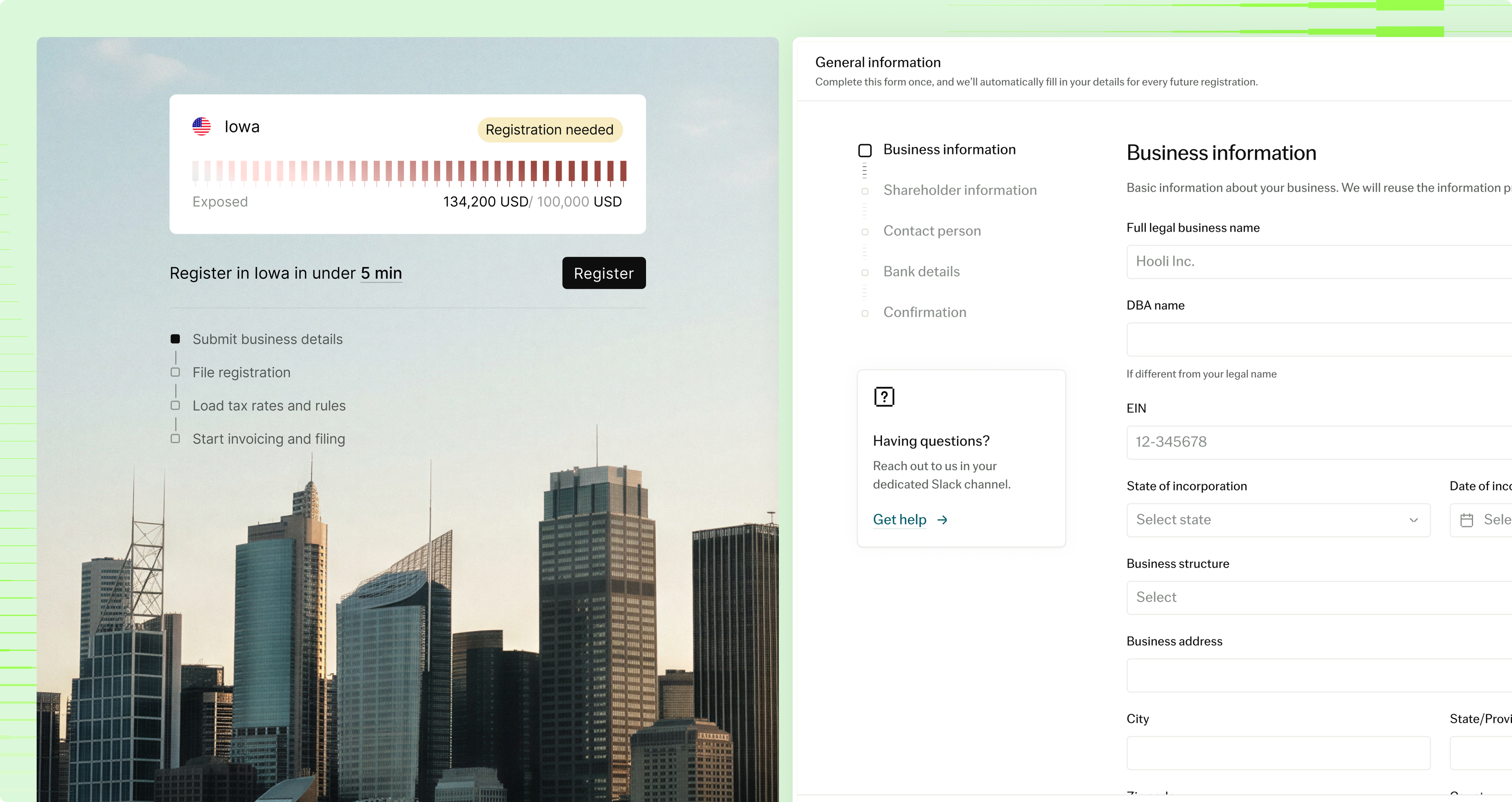
Iowa's rules are manageable on their own, but they get complicated fast once you're selling SaaS to both consumers and businesses, tracking a local option tax that varies by city, and juggling compliance across dozens of other states at the same time.
Sphere automates the full cycle of Iowa sales tax compliance:
- Monitors your Iowa sales and alerts you when you're approaching the $100,000 economic nexus threshold
- Classifies B2C and B2B SaaS transactions correctly and applies the right tax treatment automatically
- Calculates state and local option tax rates by delivery address
- Files your returns on schedule and remits payment, including for foreign businesses without a US bank account
- Manages exemption certificates so you're not scrambling to find documentation during an audit

Ready to automate Iowa sales tax compliance?
Schedule a demo with Sphere today.