New Hampshire Sales Tax: Rates, Rules & Compliance Guide


New Hampshire Sales Tax Quick Facts | |
|---|---|
New Hampshire sales tax rate: | 0% (no sales tax) |
Max state sales tax rate: | 0% (no sales tax) |
Economic nexus threshold: | N/A |
What sales count toward the threshold: | N/A |
Tax authority: | New Hampshire Department of Revenue Administration |
Tax portal: | |
SaaS taxable: | N/A |
Administration difficulty: | N/A |
New Hampshire is one of five US states with no general sales tax. The others are Montana, Oregon, Delaware, and Alaska. Software, physical goods, and services are all sold free of state sales tax in New Hampshire, and no city or county can add a local rate on top.
This does not mean all sales are tax free. Special categories like meals, lodging, communications services, and tobacco carry their own taxes, and every business operating in the state faces two separate business taxes.
This guide covers what "no sales tax" means in practice, which taxes New Hampshire does charge, and what you owe when you sell to customers in other states.
New Hampshire Sales Tax at a Glance
New Hampshire's state sales tax rate is 0%. There is no statewide sales tax, no county sales tax, and no city sales tax.
Here is what that means in practical terms:
- No state rate: New Hampshire has never had a general retail sales tax to repeal.
- No local option taxes: Unlike Alaska, which has no state rate but lets boroughs and cities charge their own, New Hampshire does not authorize local option taxes on general retail sales.
- No use tax: New Hampshire has no complementary use tax, so buyers do not self-assess tax on goods they bring into the state.
- Nothing to register for: There is no sales tax registration, no permit, and no exemption certificate to collect or store for general retail sales.
New Hampshire belongs to what tax professionals call the NOMAD states: New Hampshire, Oregon, Montana, Alaska, and Delaware.
New Hampshire also has no personal income tax on wages. The interest and dividends tax, the state's last remaining individual income tax, was repealed effective January 1, 2025. New Hampshire now has no individual income tax of any kind.
Why New Hampshire Has No Sales Tax
New Hampshire’s state motto is “Live free or die” and part of that credo is opposing taxes of all kinds. Lawmakers have tried to introduce sales and income tax proposals in the 1930s, 1960s, 1970s, and again in the 2000s, but each one has failed.
Instead, the state mainly funds itself through property tax, corporate income tax and excise taxes on things like meals, lodging, communications, tobacco and real estate transfers.
Taxable Categories: What New Hampshire Does Tax
New Hampshire taxes specific transactions rather than general retail sales. Nothing you sell as a standard retailer or software company is subject to sales tax, but several industry-specific taxes still apply.
No General Sales Tax
New Hampshire does not tax tangible personal property, SaaS, digital goods, or services. No sales tax registration, collection, or remittance is required in the state.
There is no New Hampshire sales tax calculator to run, because the rate is zero everywhere in the state.
Transaction-Specific Taxes That Still Apply
New Hampshire does have several targeted excise taxes. They include:
Tax type | Rate | Where it applies |
|---|---|---|
Meals and Rooms (Rentals) Tax | 8.5% | Restaurant meals, alcohol, hotel and short-term lodging, motor vehicle rentals |
Communications Services Tax | 7% | Two-way communications, including landline, mobile, VoIP, and prepaid wireless |
Real Estate Transfer Tax | $0.75 per $100 per party ($1.50 combined) | Sales and transfers of real property |
Tobacco Tax | $1.78 per pack of 20 cigarettes; 65.03% of wholesale price on other tobacco products | Cigarettes and other tobacco products |
The Meals and Rooms (Rentals) Tax is the closest thing New Hampshire has to a sales tax. It was enacted in 1967 and dropped from 9% to 8.5% for taxable periods beginning October 1, 2021. It covers restaurant meals, hotel stays, short-term rentals, and car rentals. Businesses selling prepared meals or lodging must abide by this tax.
Other Business Taxes NH Companies Must Know
New Hampshire replaces sales tax revenue with two business taxes that apply to nearly every company operating in the state.
Business Profits Tax and Business Enterprise Tax
New Hampshire charges a 7.5% Business Profits Tax and a 0.55% Business Enterprise Tax.
The Business Profits Tax (BPT) serves as the state’s corporate income tax. It applies to taxable business profits from activity in the state at 7.5% for taxable periods ending on or after December 31, 2023. For taxable periods beginning on or after January 1, 2025, you must file a BPT return if your gross business income from all activities exceeds $109,000.
The Business Enterprise Tax (BET) is an unusual tax. Instead of taxing profit, it taxes the enterprise value tax base, which is the sum of compensation paid, interest paid, and dividends paid. The rate is 0.55% for taxable periods ending on or after December 31, 2022. The filing threshold is more than $298,000 in gross receipts or enterprise value tax base for periods beginning on or after January 1, 2025. In practicality, this means you can owe BET even in a year with no profit.
Both filing thresholds are adjusted every two years, so check the current figures before you assume you are under them and don’t owe.
Other NH Business Tax Obligations
Beyond the two business taxes, New Hampshire employers and property owners face several other obligations:
- Withholding tax: New Hampshire has no individual income tax on wages, so there is no state income tax withholding. But employers still handle federal withholding and payroll taxes.
- Unemployment insurance: Administered by New Hampshire Employment Security, separate from the Department of Revenue Administration.
- Workers' compensation: Required for most New Hampshire employers.
- Property tax: Charged at the municipal level on real estate.
- Interest and Dividends Tax (Now Repealed): Fully repealed effective January 1, 2025.
Monitoring: Out-of-State Sales Tax Obligations for NH Sellers
Being based in New Hampshire does not exempt you from sales tax in other states. Sales delivered to customers outside New Hampshire follow the destination state's rules.
This is the single biggest compliance risk for New Hampshire companies. If you’re not accustomed to charging sales tax, you may not have systems in place to track your obligations in other states as your business grows.
The “economic nexus” rule comes from South Dakota v. Wayfair, decided by the Supreme Court in 2018. Before Wayfair, a state could only require you to collect sales tax if you had physical presence there. After Wayfair, states can require collection based on economic activity alone. If you cross another state's economic nexus threshold, you register and collect there, even though your only office is in Portsmouth.
Most states set that threshold at $100,000 in sales or 200 separate transactions in a year, but the details vary by state. Many states have now dropped the transaction count. Some measure gross sales, others measure taxable sales.
Sphere monitors economic sales tax nexus thresholds across all US states and alerts you before a registration obligation is triggered, so a growing customer base in a state like California or Texas does not turn into a back-tax problem.
Registration: What NH Businesses Need to Register For
While there is no need to register for sales tax in New Hampshire, there are still several registrations you may need.
You may need to register with the state’s sales tax portal, Granite Tax Connect, if you:
- Operate a restaurant, hotel, short-term rental, or vehicle rental business (Meals and Rooms Tax)
- Provide or resell two-way communications services (Communications Services Tax)
- Sell tobacco products
- Owe Business Profits Tax or Business Enterprise Tax
Calculation: New Hampshire Sales Tax Rates
There is nothing to calculate. The New Hampshire sales tax rate is 0% on retail goods, SaaS, digital products, and services, at both the state and local level.
Businesses in the taxed categories calculate their own rates separately:
- Meals and Rooms (Rentals) Tax at 8.5% of the taxable receipt
- Communications Services Tax at 7% of the gross charge
- Real Estate Transfer Tax at $0.75 per $100 of consideration, per party
For your sales in other states, calculation gets complicated fast. Rates change by state, county, city, and special district, and product taxability differs by state. SaaS is taxable in some states and exempt in others. Sphere calculates the correct rate and applies the right taxability treatment for every jurisdiction where you have nexus.
Filing: How and When to File New Hampshire Sales Tax Returns
There are no New Hampshire sales tax returns to file.
Businesses with Meals and Rooms or Communications Services Tax obligations file monthly through Granite Tax Connect. Both are due on the 15th of the month for the preceding month. Business Profits Tax and Business Enterprise Tax returns follow their own annual schedule based on your entity type and fiscal year.
Remittance: How to Pay New Hampshire Sales Tax
There is no New Hampshire sales tax to remit. But other taxes are remitted through Granite Tax Connect, the state’s sales tax portal.
How Sphere Helps New Hampshire-Based Businesses
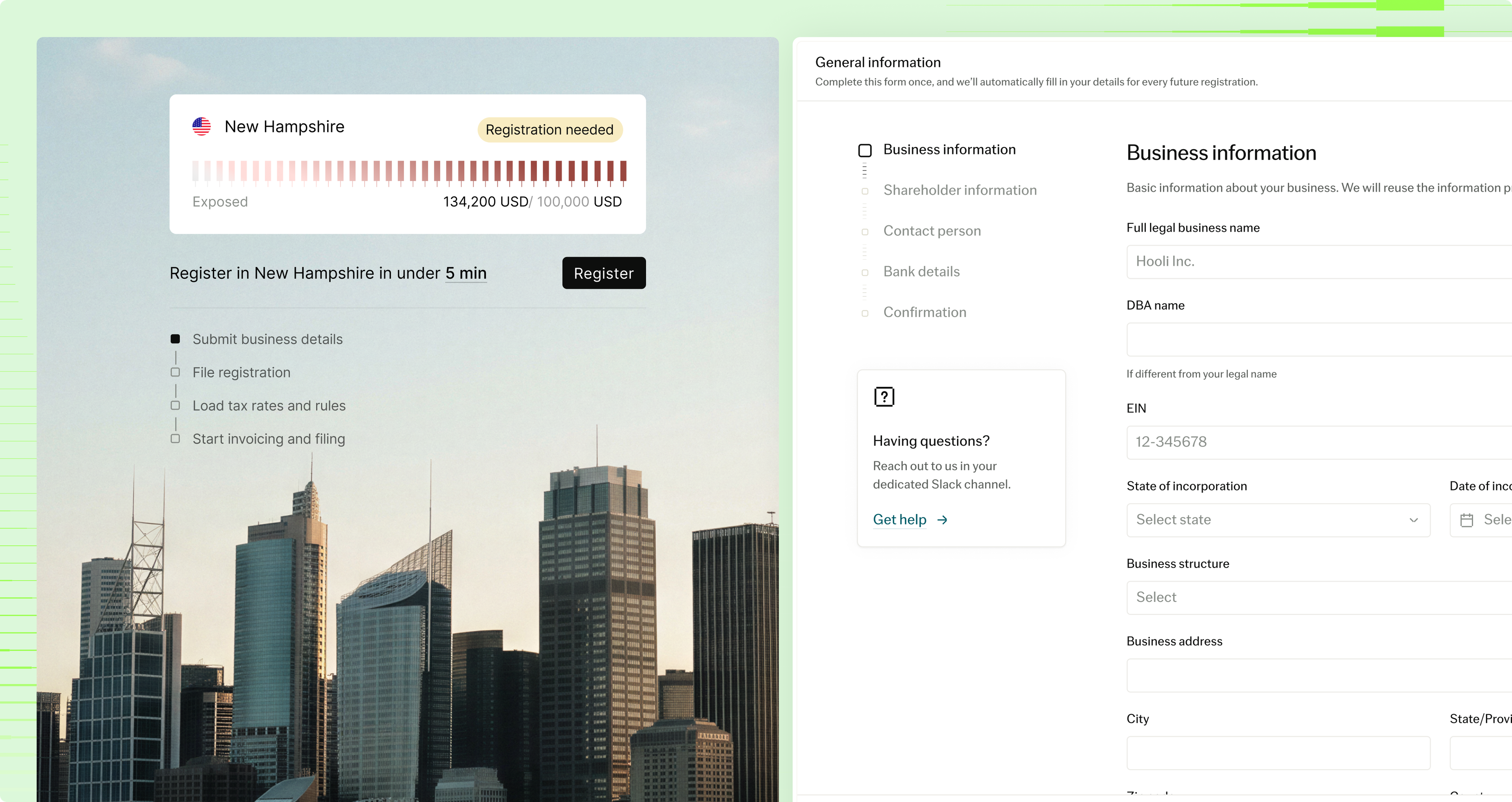
New Hampshire does not have a general sales tax, but businesses selling to customers in other states may still face sales tax obligations based on each state's nexus rules.
Sphere monitors economic nexus thresholds across all US states and helps businesses manage registration, calculation, filing, and remittance wherever sales tax obligations apply. Sphere's AI compliance engine, TRAM, tracks how each state treats your specific products, so a software subscription that is exempt in one state and taxable in the next is handled correctly without manual research.
For New Hampshire companies selling internationally, Sphere covers VAT, GST, and other indirect taxes in the same platform, with no third-party partners in the middle.
And if New Hampshire ever does introduce a sales tax, Sphere activates support for it immediately.

Selling to customers outside New Hampshire? Schedule a demo with Sphere to monitor your multi-state sales tax exposure and simplify compliance today.
See Sphere in action