4 Best VAT Compliance Software: Top Platforms Compared

Value added tax (VAT) or goods and services tax (GST) now applies in 176 countries as of January 2026. And 2026 also brings the largest wave of e-invoicing mandates yet. VAT compliance software is a tool that handles your value added tax (VAT) obligations in the countries where you sell.
But a software’s claim of "VAT support" can mean anything from a simple rate calculation to full registration, filing and remittance. Two tools can make the same claim and leave you with very different workloads.
This guide covers what VAT software does, the four best platforms, who files and who is liable, the features to verify, the rules for non-EU sellers and how to choose.
What Is VAT Compliance Software?
VAT compliance software is software that handles a business's VAT obligations on its sales. Those tax obligations are registration, rate determination, invoicing, filing and remittance. How much of that list gets covered by software depends on the vendor.
VAT is a consumption tax. It is charged at each step of the supply chain and paid in the end by the buyer. VAT is separate from income taxes, which are based on profit. GST is essentially the same tax under a different name in countries like Australia, Canada and Singapore.
VAT is a big deal to governments. According to the OECD, VAT generates more than 20% of total tax revenue on average in OECD countries. That's why tax authorities enforce it closely, even against sellers based overseas.
Here's what VAT compliance software does at a glance:
- Registration: The software registers your business with the tax authority once you hit a threshold or trigger.
- Tax determination: The software decides if a sale is taxable and which VAT rate applies. It bases this on the product and the customer's location. This includes reduced rates and VAT exemptions.
- Invoicing: The software issues compliant invoices. More and more, that means mandated e-invoicing formats and not plain PDFs.
- Filing and remittance: The software files VAT returns and pays the VAT you collected, on each country's schedule.
- Monitoring: The software tracks changes to rates and tax regulations. VAT is never a one-time setup.
It's important to note that VAT compliance software sits inside the wider indirect tax category. That category also includes US sales tax. Avalara, Vertex, Sovos and TaxJar are well-known names in that wider tax technology market.
Why Manual VAT Compliance Stops Working as You Scale Internationally
Manual VAT compliance stops working because every country runs its own VAT system. Each of the (as of January 2026) 176 VAT and GST countries has its own rates, thresholds and filing calendar. A spreadsheet that works for two or three markets does not stretch to ten.
E-invoicing adds even more work. Belgium made B2B e-invoicing mandatory on January 1, 2026. Poland's KSeF system followed on February 1 and April 1. France began its rollout on September 1. These mandates add real-time reporting and clearance rules on top of your regular VAT reporting. For countries with e-invoicing mandates, a PDF invoice is no longer enough.
In practice, one deadline is usually the trigger. A business may cross a registration threshold without noticing. Or it may be getting by on a payment platform's built-in tax feature. Then one country's e-invoicing deadline lands on the calendar. That date, not general risk, is what moves the need for dedicated indirect tax software from "someday" to "now."
4 Best VAT Compliance Software Platforms Compared
The four best VAT compliance software platforms are Sphere, Fonoa, Taxually and Stripe Tax. Each one comes from a different part of the market:
- E-invoicing and CTC specialists: Fonoa and Sovos are strongest where real-time clearance mandates apply. CTC stands for continuous transaction controls.
- Filing-focused specialists: Taxually and Marosa register and file for you. They often act as the filing layer behind a calculation tool.
- Platform-native tools: Stripe Tax calculates first and is tied to one billing platform.
- End-to-end AI-native platforms: Sphere covers registration through remittance in one system.
Traditional tax engines like Avalara and Vertex form a fifth group. They offer broad coverage built on tax matrices that research teams maintain by hand.
Provider | Category | Best for | Filing scope | E-invoicing/CTC coverage | OSS/non-resident handling | Pricing model |
|---|---|---|---|---|---|---|
Sphere | End-to-end AI-native platform | Multi-country sellers that want one vendor | Registers, calculates, files and remits | Built in. Currently supports 31 jurisdictions | Part of the standard registration and filing flow | Flat fee per jurisdiction |
Fonoa | E-invoicing and CTC specialist | Platforms and enterprises with heavy clearance mandates | Calculates, validates tax IDs and prepares returns. Confirm registration and remittance per country | Core strength. Certified platform for France | Confirm per country | Custom quote |
Taxually | Filing-focused specialist | Leaner EU sellers | Registers and files. Often paired with a separate calculation tool | Confirm per country | OSS and IOSS supported | Subscription by plan and country |
Stripe Tax | Platform-native tool | Businesses that bill through Stripe | Calculates worldwide. Own automated filing is US only. VAT filing runs through partners | Not a core feature | Calculates under OSS and IOSS registrations you add. You or a partner file | Percentage of each transaction or monthly plan |
1. Sphere
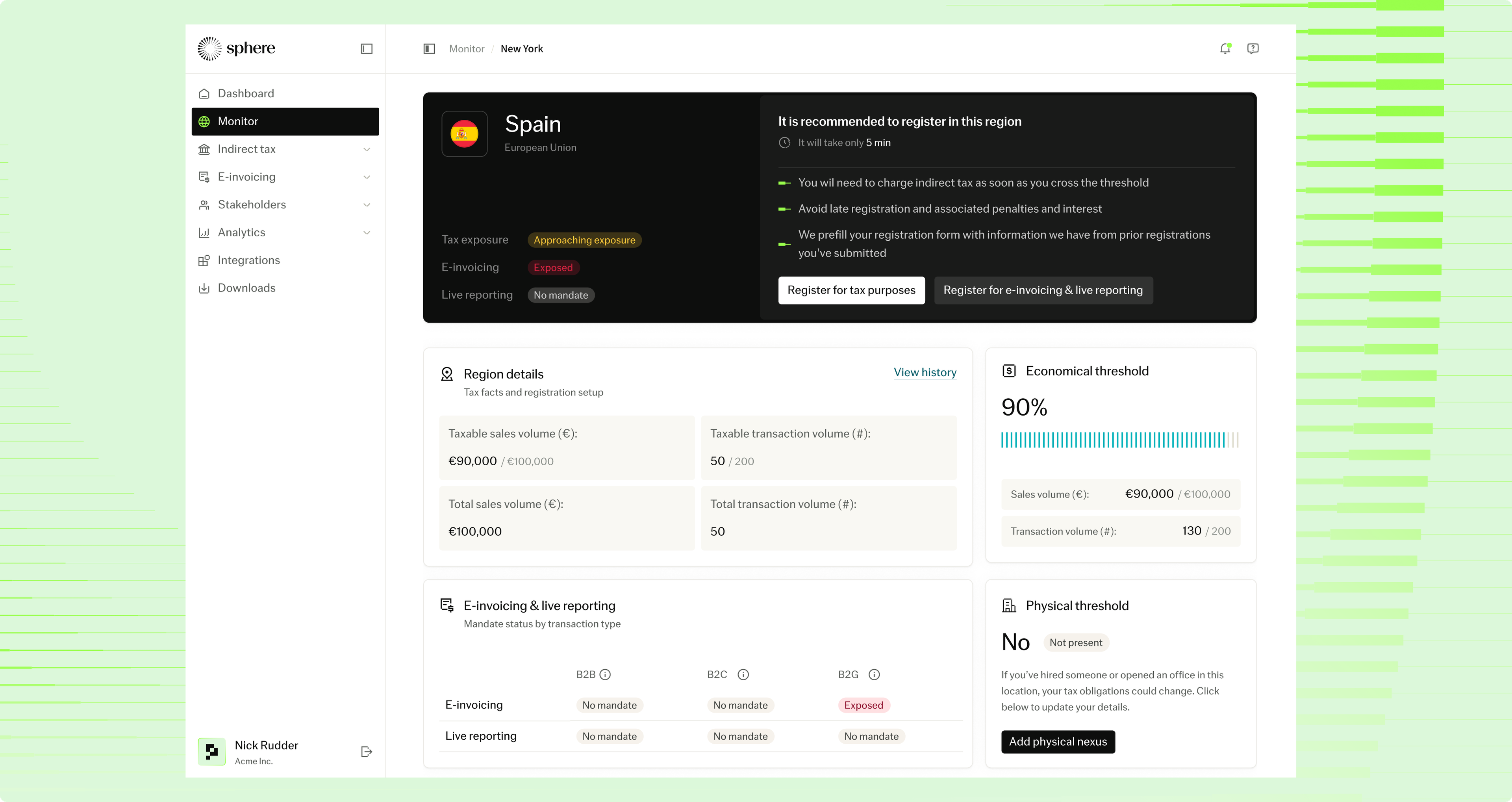
Overview: Sphere is an AI-native tax compliance platform for indirect tax. It covers end-to-end VAT registration, calculation, invoicing, e-invoicing, filing and remittance in one system. Its Tax Review and Assessment Model (TRAM) engine reads and monitors tax law directly. That keeps every tax determination current without a research team rebuilding a matrix by hand.
Best for: Businesses selling in many countries that want one vendor from registration to remittance. Sphere works for software, digital goods and physical products.
Key features:
- VAT registration, returns and remittance handled in one system, including OSS and non-resident registration
- Input VAT recovery in 32 jurisdictions and e-invoicing in 31 jurisdictions
- Real-time monitoring of thresholds, rates and rule changes
- Full audit trails from registration through remittance
- Integrations with billing and ERP systems, including Stripe, Shopify and QuickBooks
Pricing: Sphere charges a flat fee of $100 per month per jurisdiction for up to 10 jurisdictions. There is no percentage of revenue and no overage charge, so costs stay predictable as sales grow.
2. Fonoa
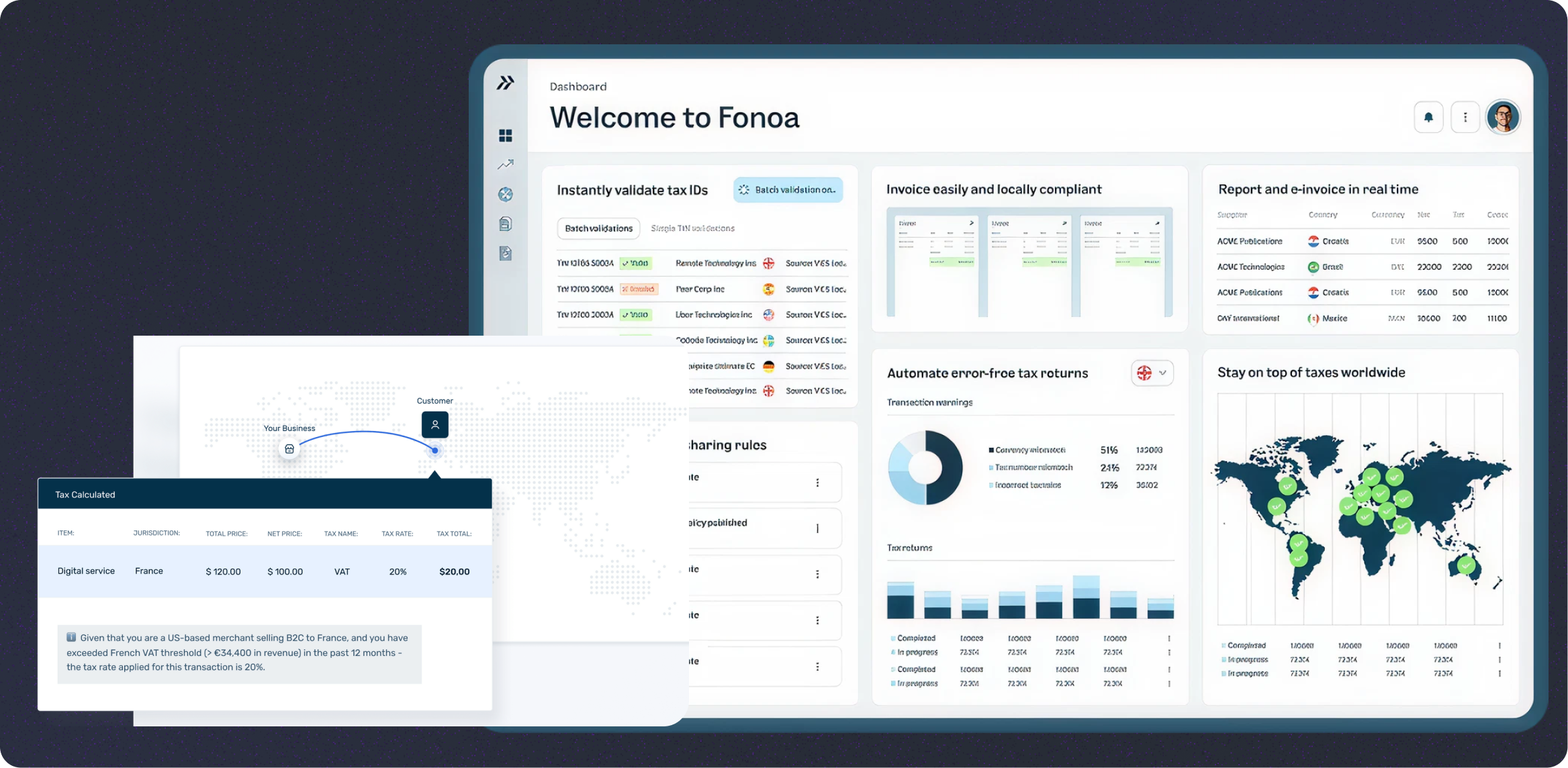
Overview: Fonoa is an API-first tax platform best known for e-invoicing and real-time reporting. It connects directly to tax authorities in mandated markets.
Best for: Marketplaces, platforms and enterprises that have developer teams and sell in many clearance-mandate countries.
Key features:
- E-invoicing through a single API
- A tax engine that covers more than 190 countries and US states
- Tax ID validation in more than 100 countries
- Returns preparation tied to invoice data
Pricing: Fonoa uses custom pricing and does not publish rates. Ask which countries include registration and remittance before you sign.
3. Taxually
Overview: Taxually is a filing-focused VAT specialist. It pairs software with VAT registration and filing services. Taxually is also one of the filing partners for Stripe Tax.
Best for: Leaner EU sellers, such as online stores, that already have a calculation tool and need someone to register and file.
Key features:
- VAT registration in the countries it supports
- VAT returns filed on your behalf
- OSS and IOSS registration and filing
- Fiscal representation where a country requires it
- A no-code connection to Stripe
Pricing: Taxually sells subscriptions. The price changes with your plan, your number of countries and your number of filings.
4. Stripe Tax
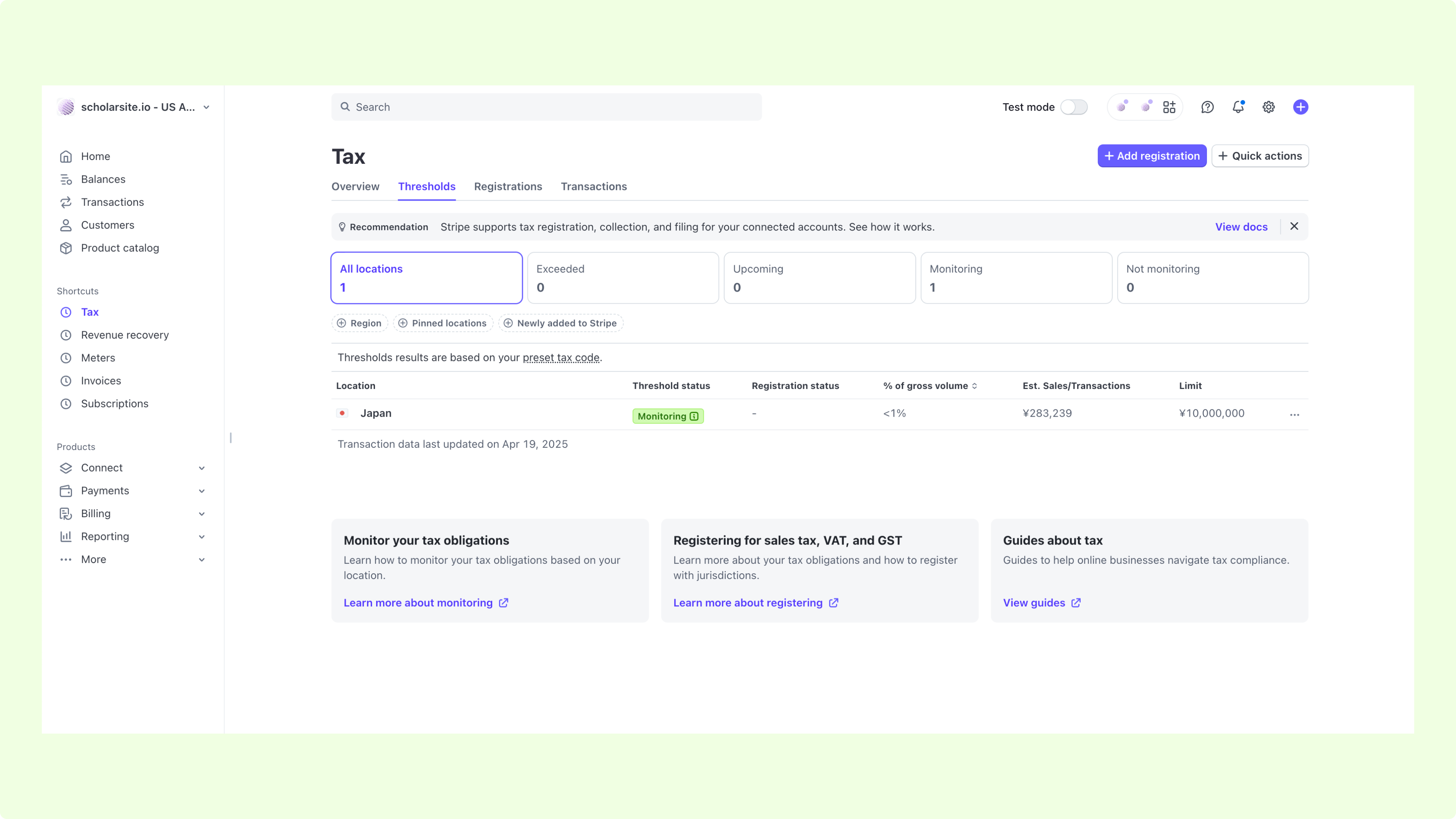
Overview: Stripe Tax is a platform-native tool built into Stripe. It calculates VAT and GST worldwide, including in every EU country. It's important to note that "Stripe Tax handles VAT" and "Stripe Tax files my VAT returns" are two different claims. Stripe's own automated filing covers US sales tax through TaxJar. VAT filing outside the US runs through partners like Taxually and Marosa.
Best for: Businesses that bill through Stripe and need calculation first.
Key features:
- Tax calculations at checkout and on invoices
- Threshold monitoring with email and Dashboard alerts
- Reverse charge on cross-border B2B sales when the customer gives an EU VAT number
- Reports you can use to self-file
Pricing: Stripe Tax pay-as-you-go pricing starts at 0.5% per transaction. Tax Complete plans start at $90 per month. Some filing partners bill separately.
VAT Compliance Models: Who Files and Who Is Liable?
VAT compliance software comes in four models. Each one gives a different answer to two questions: who submits the return, and who stays legally liable?
- Tax engines: A tax engine calculates tax and produces return data. Your in-house team submits the return. You stay liable.
- Managed or filing services: Taxually, Marosa and 1StopVAT pair software with specialists. The specialists register and file for you. You stay liable.
- Merchant-of-record platforms: Paddle becomes the seller of record on your sales. Paddle submits the return and takes on the VAT liability.
- End-to-end compliance platforms: Sphere combines VAT calculation, registration, filing and remittance in one system. Sphere submits the return with no separate filing provider. You remain the seller and the taxpayer.
Classify the specific package, not just the vendor. One vendor may offer more than one model.
Also ask who really does the filing. Some "full-service" vendors pass registration and filing to a subcontractor. This can leave customers caught between two companies. Ask who is on the hook in your contract if that relationship breaks down.
VAT Compliance Software Checklist: Features to Verify Before You Buy
Verify seven features before you buy VAT compliance software. Check each one country by country. A blanket "yes, we support VAT" is not a sufficient answer.
- E-invoicing and CTC support: Coverage should stay current as countries roll out mandates through 2026. A fixed list goes stale fast.
- OSS and IOSS handling: The tool should support the EU's One Stop Shop (OSS) and Import One Stop Shop (IOSS) along with standard per-country registration. Also check every country, return type and sales channel you need. Return types can include EC Sales Lists and Intrastat. Ask about threshold monitoring and VAT ID validation for B2B sales too.
- Input VAT recovery as a native feature: Input VAT recovery is the most common gap between what buyers assume a tool covers and what it really does. Many tools only handle the output tax you charge on sales. Recovery then stays a manual job run by an accounting firm. Sphere recovers input VAT natively.
- Fiscal representation: Some countries require a local representative for businesses with no local entity. Confirm the vendor supports those rules.
- Rule monitoring: Real-time monitoring of rates and rules beats a database that gets refreshed on a set cycle.
- Billing integration: The tool should connect directly to your billing or invoicing system. You should not export and import files every filing cycle.
- Stripe checkout: If you run on Stripe, confirm which tax providers you're allowed to use there. Don't assume any vendor will work.
VAT Compliance Software for Non-EU Sellers: OSS and Non-Resident Registration
Non-EU sellers of digital services get no EU registration threshold. Under EU VAT rules, VAT is due from the first sale to an EU consumer. You register through the non-Union OSS scheme. By contrast, EU-established sellers get a combined €10,000 annual threshold on intra-EU sales.
The non-Union OSS scheme gives you a special ID number. According to the European Commission, it uses the format EUxxxyyyyyz and can only be used for that scheme. It is not a standard VAT number.
The OSS return covers output VAT only. Output VAT is the tax you charge customers. To reclaim input VAT on your own purchases, you need a separate refund procedure or a full local registration.
Outside the EU, non-resident registration can be fully manual. Uruguay is a good example. It requires a local representative, apostilled and translated documents and in-person filing. That costs approximately $4,000 to $5,000 USD and takes weeks to a couple of months.
Confirm that your vendor covers both ends of this range. General "VAT support" may not include either one. Sphere handles OSS and non-resident registration within its standard flow.
How to Choose the Right VAT Compliance Software for Your Business
Choose VAT compliance software with two filters. The first filter is where and how you file. The second filter is your stack, your scale and your team.
Filter by where and how you file:
- A single-country UK seller may only need accounting software that works with Making Tax Digital (MTD). HMRC lists recognised options.
- Multi-country, OSS and non-resident filers need coverage for every filing route they use.
Filter by stack, scale and in-house expertise:
- List the integrations you need, such as billing tools and ERP systems.
- Count your transaction volume and your number of legal entities.
- Decide whether a tax team will review returns or you need filing handled end to end.
Here's the short version:
- Sphere is for businesses that want registration through remittance, e-invoicing and input VAT recovery in one system.
- Fonoa is for footprints heavy in clearance mandates.
- Taxually is for leaner EU sellers.
- Stripe Tax is for businesses that bill through Stripe.
Frequently asked questions

Ready to automate VAT compliance from registration to remittance?
Schedule a demo with Sphere today