



Stay Informed
Enter your email address to stay up to date on new releases


Sales tax sneaks up on SaaS companies. You launch with a handful of customers in your home state, then suddenly you're processing thousands of subscriptions across dozens of states. By the time you realize you've crossed economic nexus thresholds in multiple jurisdictions, you're staring at potential back taxes and penalties.
The problem gets worse because SaaS billing doesn't map cleanly to state tax laws and rules. Prorations, upgrades, downgrades, and cross-border transactions create edge cases that manual tracking can't handle. Once you're dealing with multiple tax jurisdictions, spreadsheets fail fast.
This guide compares the best sales tax compliance software solutions built for SaaS companies. We'll explain what features actually matter for subscription businesses and help finance teams choose a platform that fits their growth stage and tech stack.
What Modern Sales Tax Compliance Software Needs to Handle
Modern sales tax software for SaaS must do more than calculate rates. It needs to understand subscription billing complexities and automate the entire tax lifecycle.
Automation Across the Full Tax Lifecycle
From registration, to collection, to filing tax returns and remittance, your sales tax software should streamline every sales tax related task.
You must watch when you cross nexus limits in new areas. You also need to know how to collect the right tax rate on every SaaS product in each area. You must manage special cases like exemption certificates.
Without full lifecycle automation, you're still stuck with manual work that creates compliance risk.
Real-Time Tax Calculation for SaaS Revenue
Traditional sales tax calculators can’t handle SaaS. Rather than customer location, SaaS companies need to charge tax based on billing addresses. And software must understand that each US state has its own rules and laws on SaaS tax management. And last but not least when it comes to tax reporting, tax calculation software needs to handle the reality of SaaS subscriptions, including proration, mid-cycle upgrades or downgrades, credits, and refunds.
Integrations With Billing, ERP, and Checkout
Tax automation is only as useful as the data it has to work with. Your sales tax software should integrate with your billing system, ERP systems, and sales channels. Without these integrations, you're copying data between systems and creating reconciliation headaches.
Jurisdiction Coverage and Global Readiness
Most companies dream of growing cross-border. Your tax software needs to not only handle the complexity of sales tax in 46+ US states, but also grow with you as you expand into other countries. This means handling not just sales tax, but VAT, GST and other taxes, such as Japan’s JCT. The best sales tax platforms let you know when you trigger tax nexus in a new country, and register your business seamlessly.
Without international coverage, your business will need to switch platforms as soon as you go global.
Best Sales Tax Compliance Software for SaaS
We've ranked the leading tax automation tools by their SaaS-specific features, automation depth, and ability to scale across jurisdictions.
1. Sphere
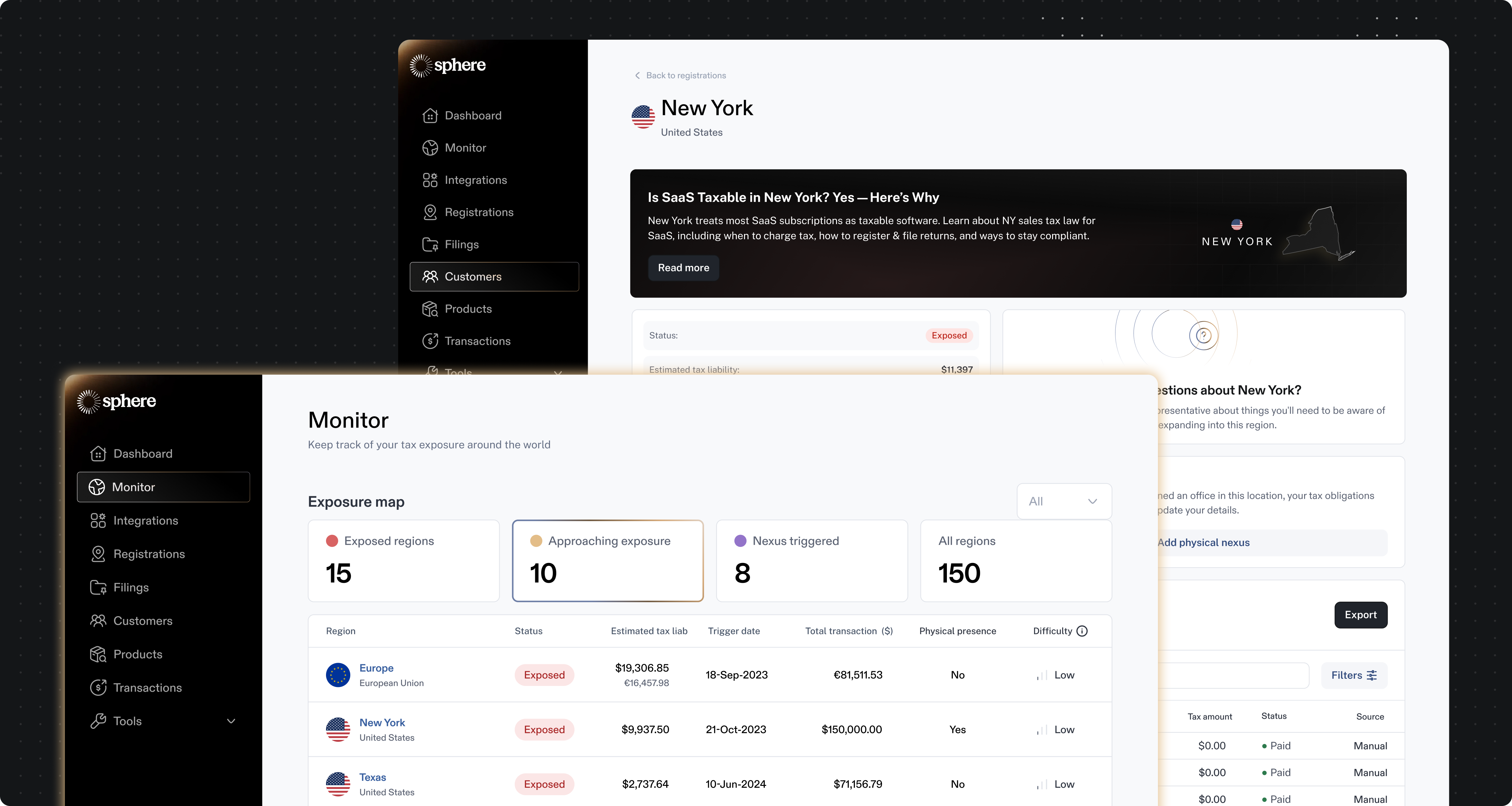
Sphere built its platform specifically for modern technology companies dealing with complex domestic and cross-border compliance.
Best For
Series A through Series C SaaS companies need tax compliance that scales with their growth. US-based teams with global customer bases, or who plan to cross-borders as part of strategic growth, benefit most from Sphere's unified approach to domestic and international tax.
Key Capabilities
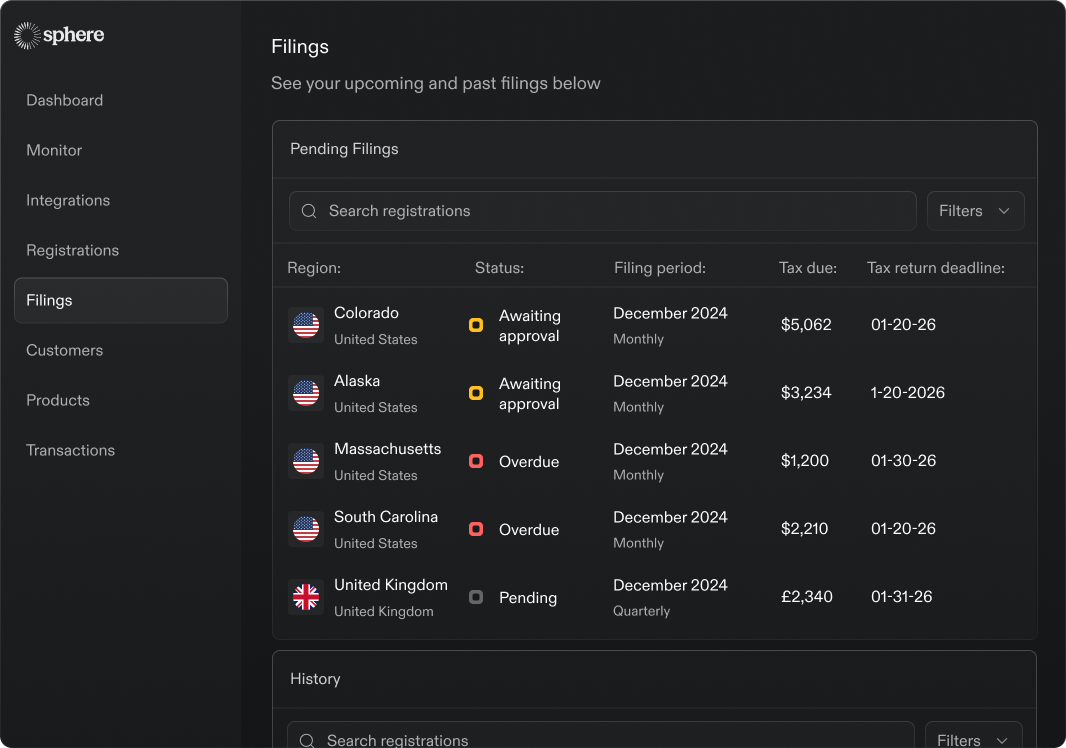
Sphere's AI-driven tax determination uses the Tax Review and Assessment (TRAM) model. It automatically understands and applies tax rules in different areas. The platform monitors nexus thresholds in the US and abroad and alerts you before registration is required.
Real-time tax calculation happens at the API level, integrating directly with your billing system. Automated returns filing and remittance eliminate the manual work of tax compliance. The API-first architecture means developers can integrate Sphere in hours, not weeks.
SaaS Fit Assessment
Sphere was designed from day one for SaaS and digital products. It handles subscription billing complexities like upgrades, downgrades, and prorations without custom configuration.
The platform manages cross-border sales natively. There is no need for separate US and international solutions as your business scales. Developer teams appreciate the clean API documentation and quick implementation. Finance teams like the flat $100 per jurisdiction pricing with no per-transaction fees or overages.
2. Avalara
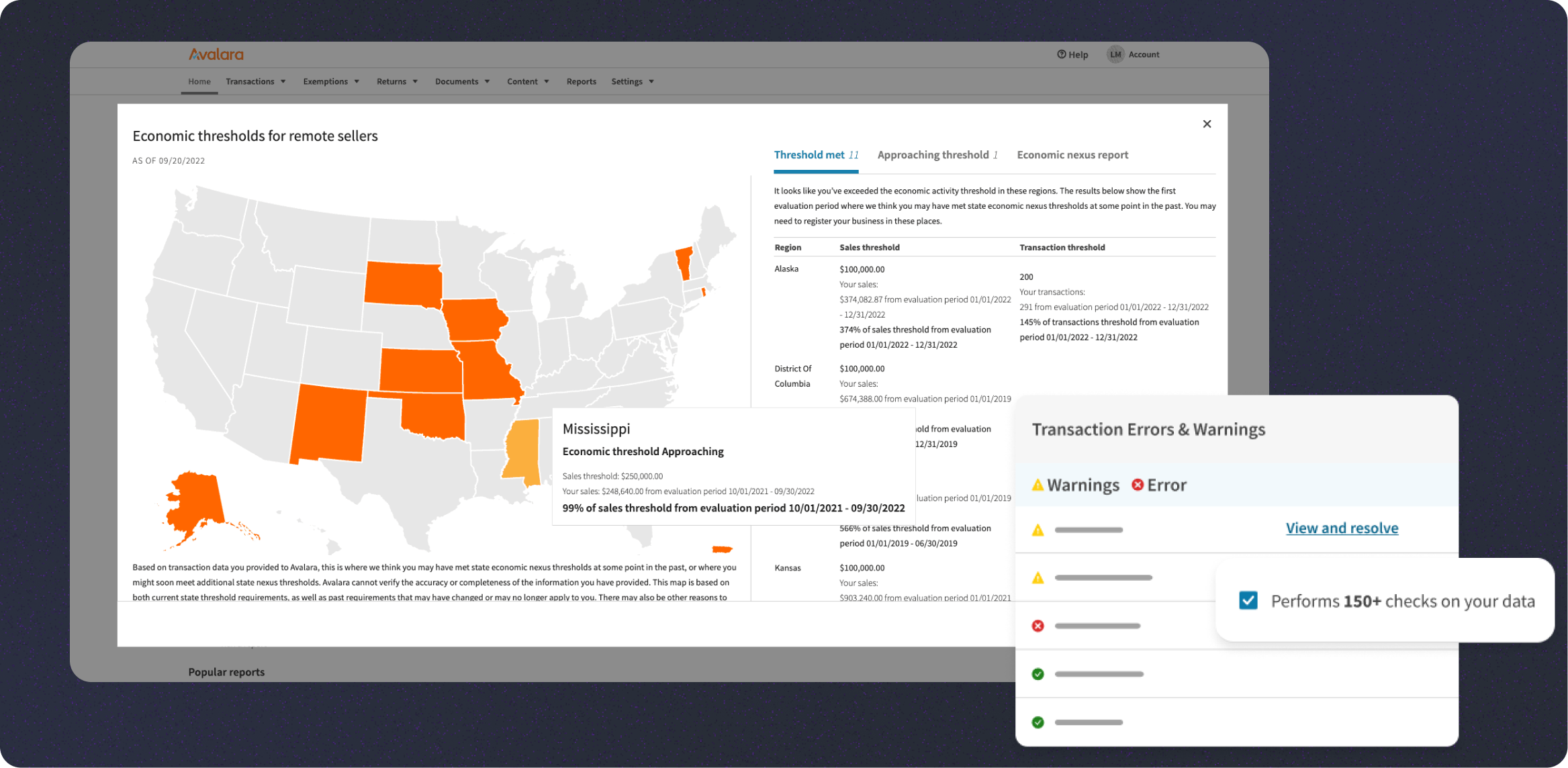
As the legacy solution in the US sales tax space, Avalara brings enterprise-grade compliance to companies with complex requirements.
Best For
Large SaaS companies with dedicated tax teams need Avalara's depth of features. Companies processing millions of transactions across all US states benefit from the platform's scale.
Key Capabilities
Avalara offers extensive integrations with major ERP and billing platforms. The solution’s sales tax calculation handles high transaction volumes without latency issues. The exemption certificate management system checks and stores tax-exempt documents automatically. Returns filing services cover all US jurisdictions with managed filing options available.
SaaS Fit Assessment
Avalara supports SaaS taxability rules but wasn't built specifically for subscription businesses. The platform handles standard invoicing well but requires customization for complex SaaS billing scenarios.
Implementation typically takes months and requires significant IT resources. Pricing includes per-transaction fees that can become expensive at scale.
3. TaxJar (by Stripe)
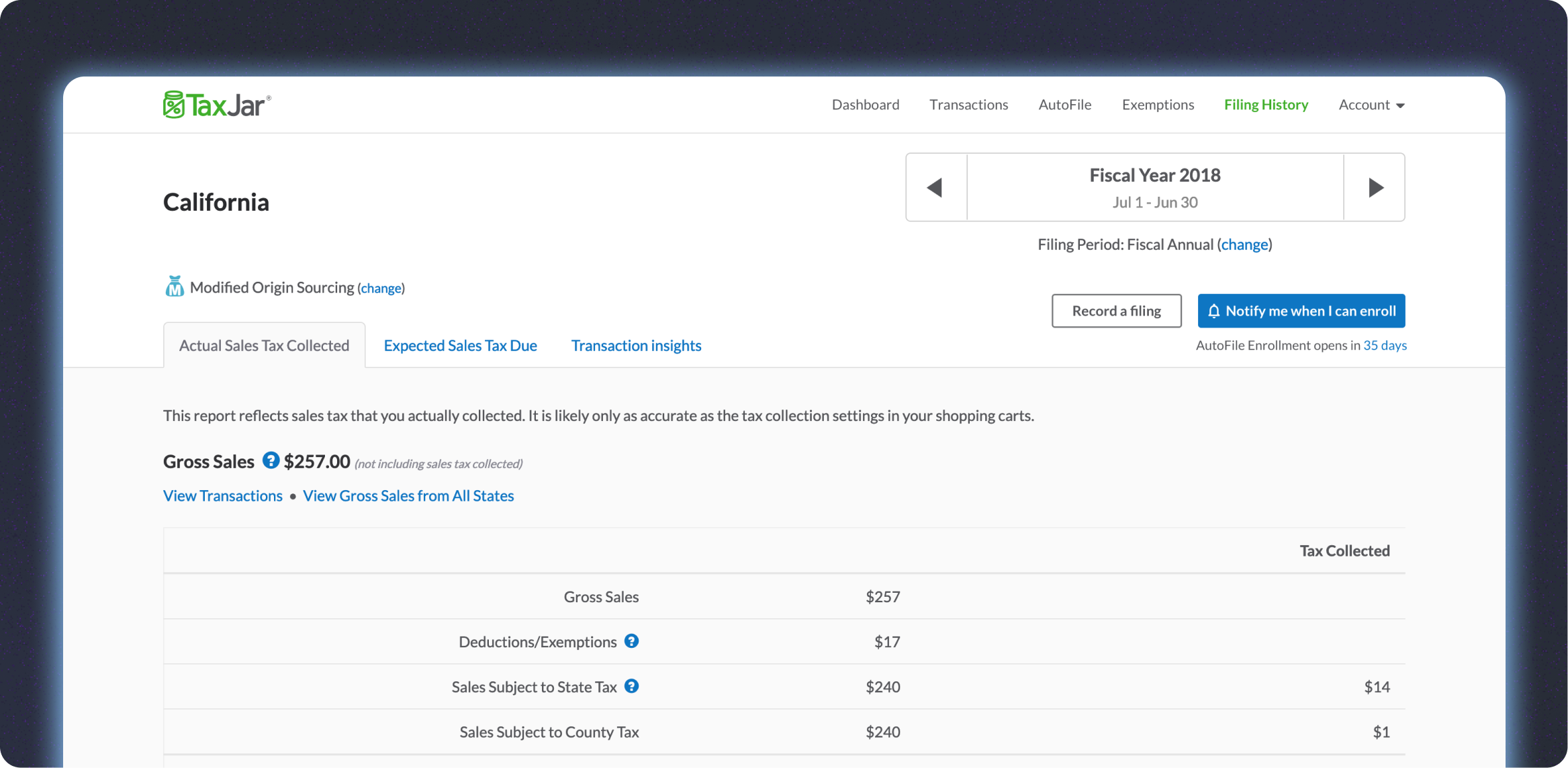
TaxJar simplifies sales tax for growing US-based companies, especially those already using Stripe for payments.
Best For
Small to mid-size SaaS companies want simple sales tax automation without complexity. Teams already using Stripe benefit from native integration and unified billing.
Key Capabilities
Automated sales tax calculation works seamlessly with Stripe subscriptions. AutoFile handles returns filing and remits sales tax payments for all states where you have nexus.
The platform includes basic nexus monitoring and economic threshold tracking suitable for small business. Integration with major ecommerce platforms provides flexibility beyond SaaS.
SaaS Fit Assessment
TaxJar offers a simple setup for basic subscription billing through Stripe. The platform handles standard SaaS scenarios but struggles with complex edge cases. As a US-only solution, TaxJar offers no international support. Advanced features like exemption management also require manual workarounds.
4. Anrok
.png)
Anrok built its platform specifically for SaaS companies, understanding the unique challenges of subscription revenue.
Best For
US-focused mid-market SaaS companies need purpose-built tax compliance. Companies with complex SaaS billing models benefit from Anrok's specialized logic.
Key Capabilities
SaaS-native taxability logic handles subscription-specific scenarios automatically. The platform covers home-rule jurisdictions that other solutions might miss. Deep integrations with accounting and billing systems eliminate manual data entry. Custom tax rules accommodate unique business models and edge cases.
SaaS Fit Assessment
Anrok excels at SaaS revenue models because that's all it was built to handle. The platform understands upgrades, downgrades, credits, and other SaaS complexities natively.
Global functionality is still expanding, making it less suitable for international companies. Pricing also scales with revenue, which can become expensive for high-growth companies.
5. Vertex
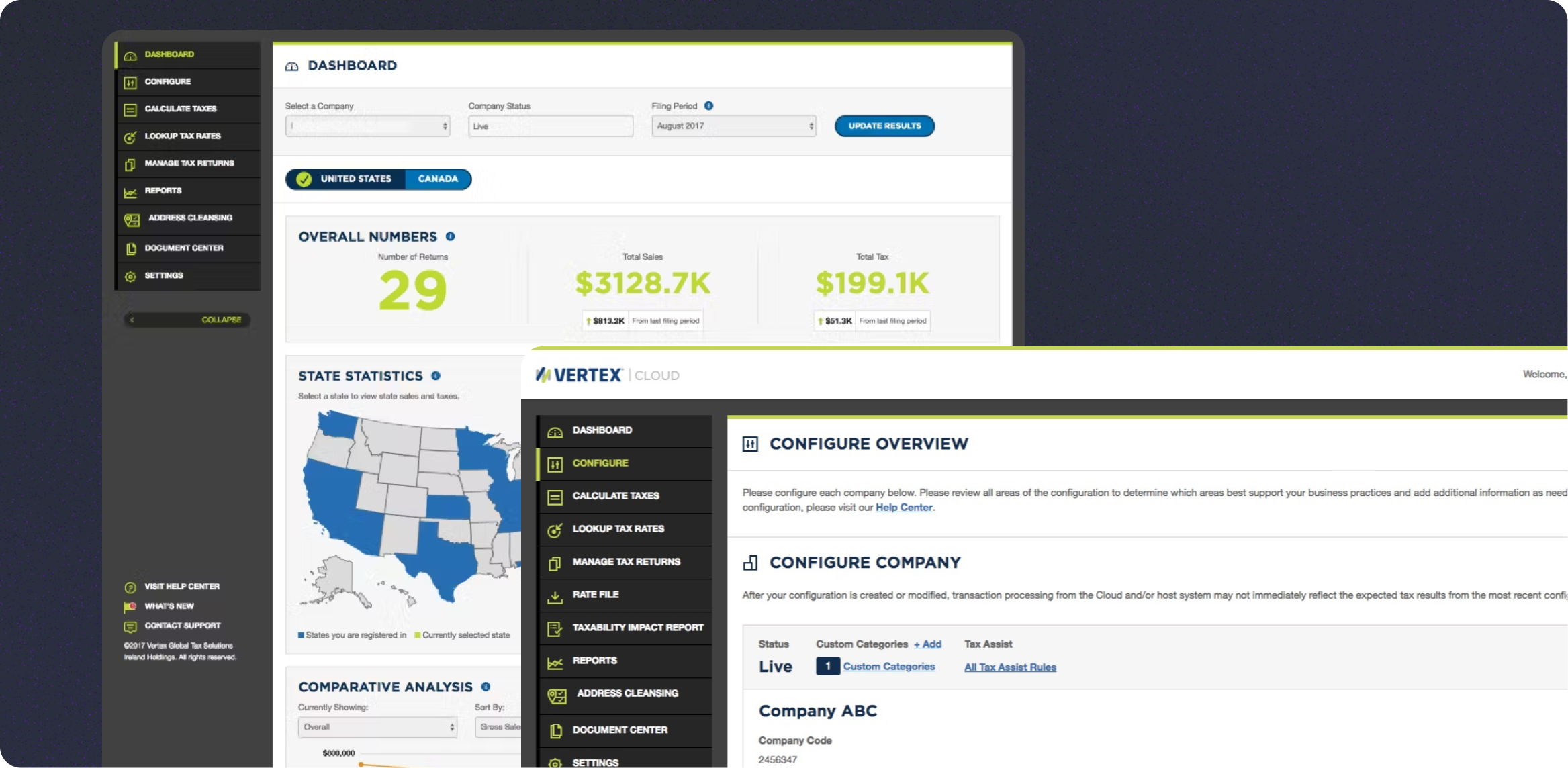
Vertex provides comprehensive tax solutions for large enterprises with complex, multi-jurisdiction operations.
Best For
Enterprise SaaS companies with dedicated tax departments can benefit from Vertex's power. Companies working in many countries with complex tax rules benefit from the platform's flexibility.
Key Capabilities
The advanced tax determination engine handles virtually any tax scenario. Broad indirect tax coverage includes sales tax, VAT, GST, and other transaction taxes.
Deep ERP integrations connect with SAP, Oracle, and other enterprise systems. Configurable workflows support complex approval and compliance steps.
SaaS Fit Assessment
Vertex is powerful but requires significant implementation effort and expertise. The platform handles any tax scenario but needs extensive configuration for SaaS-specific requirements.
Internal tax expertise is necessary to configure and maintain the system. Implementation typically takes 6-12 months with substantial IT involvement.
How SaaS Teams Should Choose Sales Tax Software
Choosing the right sales tax software depends on your team structure, technical stack, geographic footprint, and pricing tolerance.
Team Size and Ownership
Small teams need self-serve platforms that don't require tax expertise. The software should file taxes automatically without manual work.
Larger teams might benefit from managed services where the vendor handles filing. Companies with their own tax teams may need calculation and tax logic, but handle filing in house.
Billing and ERP Compatibility
Your tax software must integrate with your existing billing platform. Check that the software syncs with your accounting system or ERP, like QuickBooks, NetSuite, or SAP. API flexibility matters if you have custom billing flows that don't fit standard templates.
US Sales Tax Versus Global Expansion
US-only companies can choose simpler solutions focused on state compliance. But if you plan to sell internationally, choose a platform with native VAT and GST support.
Consider registration and remittance scope. Some platforms only calculate tax, while others handle the entire compliance process. Switching tax platforms later is painful, so think about your 3-5 year trajectory before choosing a SaaS tax solution.
Pricing and Support Model
Flat pricing provides predictability as you scale, while per-transaction fees can spiral. Some vendors charge for each tax calculation, which adds up quickly for growing SaaS companies.
Human customer support availability matters when you hit edge cases or audit situations. Check response times and whether support costs extra. Consider how pricing scales. Will success make the software unaffordable?
The Best Sales Tax Software Is the One That Scales With You
Sales tax complexity compounds exponentially as your SaaS company grows. What starts as simple compliance in one state becomes a multi-jurisdiction puzzle that threatens to overwhelm your finance team.
Automation is necessary. In today’s tax landscape, it's the only way to maintain compliance without drowning in manual work. The operational risk of non-compliance grows with every new state where you have nexus.
SaaS-specific logic matters more than brand recognition when choosing tax software. Generic solutions require workarounds and customization that create long-term maintenance headaches.
Your tool choice should align with your current growth stage while accommodating future expansion. Choose a platform that can handle both your immediate needs and your ambitious growth plans.
You Might Like
.png)

Make selling globally as easy as selling locally
Join industry leaders using Sphere to streamline global compliance processes.


