



Enter your email address to stay up to date on new releases



Imagine your company just closed a software deal with a client in Germany. When the payment arrives, a chunk of it is missing. The German payer withheld tax before sending the funds because they had no proof you were a US resident entitled to treaty benefits.
That missing money is exactly what a tax residency certificate is designed to prevent.
A tax residency certificate (TRC) is an official document issued by the IRS that proves your status as a US tax resident. Foreign tax authorities, banks, and payers use it to confirm you qualify for reduced withholding rates under a bilateral tax treaty. Without one, you pay more tax than you should.
This guide covers what a TRC is, who needs one, how to apply for it, how long it takes, and what Sphere's upcoming withholding tax functionality means for your cross-border compliance.
What Is a Tax Residency Certificate?
Definition and Purpose
A US tax residency certificate is an IRS-issued letter certifying that a person or business entity is a resident of the United States for federal income tax purposes during a specific tax year.
In the US, this certificate is Form 6166. It is printed on official US Department of the Treasury stationery. Foreign governments, banks, and tax authorities accept it as proof that you are a US resident eligible for treaty protections.
There are two forms involved here, and it helps to keep them straight:
- Form 6166 is the certificate itself. You hand this document over to a foreign authority.
- Form 8802 is the IRS application you submit to request Form 6166.
You cannot get one without the other. The IRS requires Form 8802 for all requests, no exceptions.
What It Proves and What It Doesn't
Form 6166 certifies your US tax residency status for US tax treaty purposes. That is it.
It does not confirm that you paid US taxes, and it cannot be used to claim foreign tax credits. What it does is give a foreign payer the documentation they need to apply a lower, treaty-reduced withholding rate to your payment instead of the standard domestic rate.
Most foreign governments will not apply a treaty rate without this letter in hand.
Why You Need a Tax Residency Certificate
Proof of Residency for Withholding Tax Purposes
When a foreign country sends money to a non-resident, they typically withhold tax before the payment goes out. This is withholding tax, and the default rates are high. Many countries withhold at 25% to 30% on payments like dividends, royalties, interest, and service fees.
The US has bilateral tax treaties with dozens of countries. These treaties set lower, negotiated withholding rates. These are often 15% or less, depending on the specific treaty and payment type. But to use those lower rates, you have to prove you are a US resident.
That proof is Form 6166.
Without it, the foreign payer has no basis to apply the treaty rate. They withhold at the full domestic rate, and you are left chasing a refund from a foreign tax authority, which is not a simple process.
Other Common Use Cases
A TRC is not only useful for withholding tax. You may also need one for:
- VAT exemptions. Some countries, including several in the EU and Asia-Pacific, will grant VAT relief to US entities that can prove residency status. The IRS notes that Form 6166 can be used for VAT exemption purposes, though it only certifies US federal income tax residency. You may have to meet the foreign country’s other requirements.
- Foreign bank account compliance. Some international banks require IRS residency certification before opening accounts for US entities.
- Regulatory filings abroad. Certain foreign tax authorities require IRS-certified residency documentation as part of their standard compliance processes.
What Happens If You Don't Have One
Higher Withholding Rates
The most immediate consequence is that you pay more.
Without a TRC, foreign payers apply their domestic withholding rate to every eligible payment. If the treaty rate for royalties between the US and a given country is 10% but the domestic rate is 30%, you are leaving 20 percentage points on the table every single time a payment is made.
For a company doing significant cross-border business, that adds up fast.
Retrospective Reclaim Is Difficult
You can file a refund claim with a foreign tax authority to recover over-withheld tax after the fact. But this is slow, paperwork-heavy, and varies widely by country.
Some jurisdictions have strict deadlines for reclaim filings. Miss the window, and you forfeit the refund entirely. Others require documentation that can be hard to gather retroactively.
Getting the TRC upfront is almost always easier than trying to recover money after it has already been withheld.
Compounding Exposure at Scale
Operating without a TRC across multiple countries creates a growing pile of excess withholding. The more countries you sell into, and the higher your transaction volume, the more this exposure compounds.
For a company expanding internationally, this is a risk that quietly scales with the business.
Who Is Eligible for Form 6166
Standard Eligibility
The IRS will issue Form 6166 to:
- US citizens and resident aliens who file US federal tax returns
- US business entities such as corporations, partnerships, LLCs, and trusts that have US federal tax filing obligations
The key factor is actual tax residency status for the tax year you are requesting certification for. Having a US address or doing business in the US is not enough on its own. Eligibility is directly tied to your filing status with the IRS.
Dual-Status Individuals
Part-year US residents face more complex rules. If you were only a US resident for part of the year, the IRS may limit the certification to that portion of the year.
If residency cannot be clearly established for the requested period, the IRS can deny the application. In these cases, it is worth consulting a tax professional before applying.
How to Get a Tax Residency Certificate: Step by Step
Step 1: Complete Form 8802
First, fill out IRS Form 8802, Application for United States Residency Certificate.
The form asks for:
- Your taxpayer identification number (TIN)
- The tax year(s) for which you need certification
- Each foreign country where you plan to use the certificate (listed separately)
Who signs the form depends on the entity type. Individuals sign for themselves. For businesses, an authorized officer or partner must sign. The IRS will not process an unsigned or improperly signed form.
Step 2: Pay the User Fee
The IRS charges a non-refundable fee to process every Form 8802 application:
- Individual applicants: $85 per application
- Business entities and other non-individual applicants: $185 per application
These fees do not guarantee approval. If the application is denied, the fee is not returned. Check the current Form 8802 instructions for the most up-to-date fee amounts, as these are subject to change.
Note: As of September 29, 2024, applicants must upload a copy of Form 8802 when making payment through Pay.gov. However, uploading to Pay.gov is not a substitute for mailing or faxing the actual application.
Step 3: Submit to the IRS
Mail or fax your completed Form 8802, along with any required supporting documentation, to the IRS Philadelphia Accounts Management Center. The form instructions specify the correct address and fax number.
Check the IRS website for the latest submission guidance, as procedures and addresses can be updated.
Step 4: Wait for Processing — and Plan Ahead
The IRS states a minimum processing time of 45 days for Form 8802. In practice, it can take up to three months, depending on application volume and complexity.
The IRS does not offer expedited processing for standard requests. If you need Form 6166 by a specific deadline, such as for a foreign filing, a bank requirement, or a payment window, apply well in advance. Waiting until the last minute is a reliable way to end up with an uncovered withholding exposure.
Step 5: Submit to Foreign Authorities
Once you receive Form 6166, you present it to the relevant foreign tax authority, bank, or institution.
A few things to keep in mind:
- Some countries require additional steps beyond submitting Form 6166 directly. You may be required to provide Apostille authentication, embassy attestation, or a notarized translation.
- Indonesia, for example, has its own specific rules. US taxpayers should refer their local withholding agents to Indonesian Circular Letter No. SE-48/PJ/2013 and Indonesia Regulation No. PER-25/PJ/2018. In that jurisdiction, Form 6166 replaces specific sections of Indonesia's DGT forms.
- Always verify the exact requirements with the foreign authority before submitting.
Annual Renewal and Reprints
Certificate Is Year-Specific
Form 6166 certifies residency for one specific tax year. If you want to claim tax treaty benefits in a foreign country the following year, you need a new certificate for that year.
This means Form 8802 is not a one-time filing. If your company does regular cross-border business, you should expect to apply annually, and build the 45-to-90-day processing window into your planning cycle.
Reprints
If your Form 6166 is lost or you need additional copies, the IRS can provide reprints of previously issued certificates.
What to Do If Your Application Is Denied
Review the Denial Notice
If the IRS denies your Form 8802 application, it will send a notice explaining why. The most common reasons are:
- Unable to establish residency for the requested tax year
- Missing or incomplete documentation
- Application not properly signed
Next Steps
Correct the issue identified in the denial notice and resubmit with the required supporting documentation.
If the denial is based on a genuine dispute about your residency status, consult a tax professional with international tax experience. The IRS also has a process available in cases where double taxation has occurred or is expected, and the taxpayer believes they qualify as a US resident for treaty purposes.
How Sphere Helps With Withholding Tax Compliance
.png)
To be clear: Sphere does not automate the TRC application process. Obtaining Form 6166 requires direct engagement with the IRS, and that is a step your team handles directly.
But Sphere does handle what comes after.
Withholding Tax Functionality
Sphere is releasing withholding tax functionality that will categorize your products and services for withholding tax purposes across jurisdictions. Once your TRC is in place, Sphere will help ensure that the correct treaty-reduced rates are being applied to eligible cross-border transactions automatically, without requiring your team to manually look up rates by country and payment type.
This is vital because getting the rate right is not a one-time task. Withholding rates vary by treaty, by payment type, and by country-specific rules. Managing this manually across multiple markets is time-consuming and error-prone. Sphere handles it automatically.
Part of a Unified Global Compliance Platform
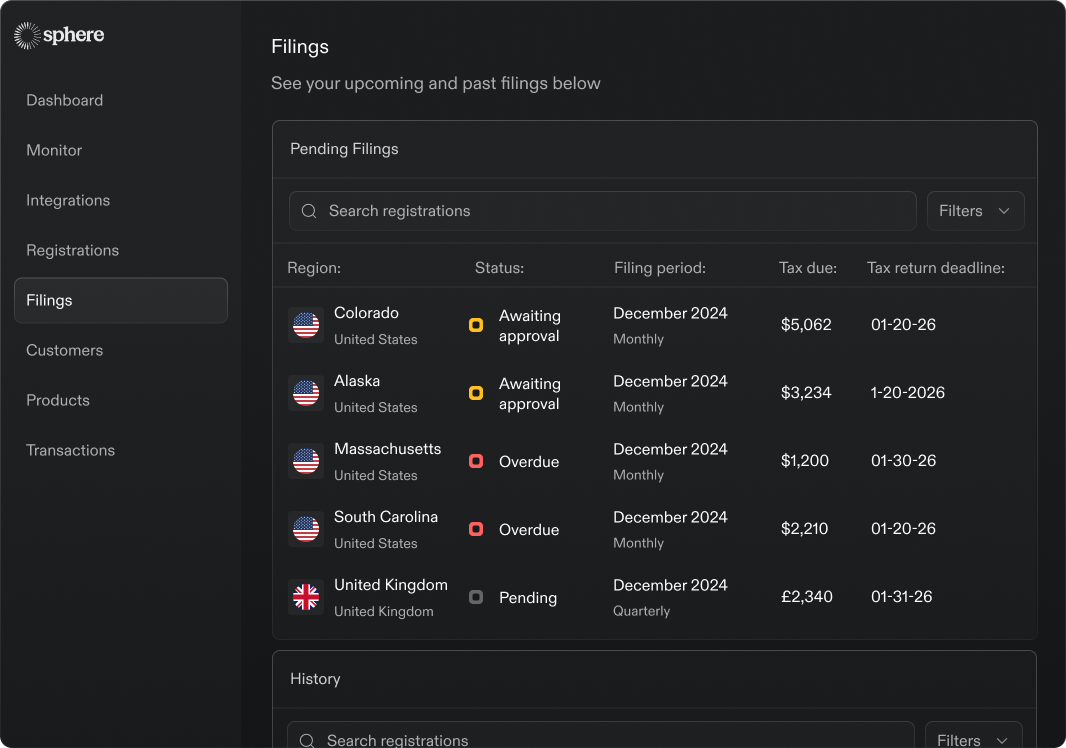
Sphere already covers nexus monitoring, registration, tax calculation, filing, and remittance for sales tax, VAT, and GST in markets around the world. Withholding tax extends that coverage — giving finance teams one platform for cross-border indirect tax compliance instead of a collection of disconnected tools and manual processes.
Apply Early, Renew Annually, and Automate What Comes Next
A US tax residency certificate is the document that allows your company to access treaty-reduced withholding rates on foreign income. Without it, foreign payers default to full domestic rates which are often 25% to 30%. And recovering that money after the fact is difficult, slow, and sometimes even impossible.
The application process involves Form 8802, a non-refundable user fee, and a processing window of 45 days to three months. Early planning is paramount.
Once the certificate is in place, Sphere's forthcoming withholding tax functionality ensures the right rates are applied to your cross-border transactions, automatically and at scale.
You Might Like




Make the world
one market
End-to-end compliance automation for sales tax, VAT, and GST. 100+ regions. One platform. Built by 50 people who believe the compliance cost of every transaction should be zero.


